




I went down a rabbit hole last week. Fifteen articles about 10k gold rings. I wanted to see what people are reading before they end up on our site. And honestly? I closed my laptop kind of annoyed.
The same recycled talking points, over and over. 10k is more durable. 10k scratches less. 10k is the smart choice.
Written by who, exactly? Because it was not written by anyone who has ever poured molten gold into a flask or filed a ring shank down to its final shape.
Our family, the Vouclos family, has been making gold jewelry in Athens since 1953. I am the third generation at the bench. I design every ring we sell in Rhinoceros 3D, and then I walk across our workshop and watch it get cast, cleaned up, polished, and finished by hand. I have done this with 10k gold and 14k gold more times than I could ever count.
So let me just tell you what is actually true and what is recycled marketing copy.
What the Numbers Mean (Quick Version)
Pure gold is 24 karats. Beautiful to look at, impossible to wear. Too soft. It would literally deform on your finger.
So we mix it with other metals. Silver, copper, zinc. That makes it strong enough to be a ring.
10k gold: 41.7% pure gold.
14k gold: 58.5% pure gold.
That is the entire difference. Both are real, solid gold. Not plated. Not filled. Not "gold tone" or whatever marketing term you have seen floating around. The gold goes all the way through, edge to edge, top to bottom.
In America, 10k is the legal minimum to call something gold jewelry. In Greece, where I grew up and where our workshop still operates, 14k has been the go to for as long as anyone remembers. Both have been used in fine jewelry for a very long time. Neither is fake. Neither is inferior.
And neither will tarnish, peel, or turn your skin green. If that is happening to a ring you own, I promise you it is not solid gold. That reaction comes from plated pieces where the base metal underneath starts reacting with your skin once the thin gold layer wears away. Solid gold does not have an "underneath."
Color: Closer Than You Think
Here is something I can say with confidence because I literally stare at both karats every day in our workshop.
10k yellow gold and 14k yellow gold are about 95% the same color. I measured this with my eyes, not a spectrometer, but after all these years I trust my eyes.
14k is a touch warmer. A little more depth. That rich, classic gold glow that people picture when they close their eyes and think "gold." 10k pulls ever so slightly cooler. A fraction toward pale yellow.
On a white countertop under workshop lighting? I can see it. On somebody's hand at a restaurant? I genuinely cannot. And I have been doing this my whole adult life.
Now, rose gold is a different conversation. The copper ratios change things more visibly there. White gold too. But in yellow gold, which is what 90% of people are thinking about when they search for gold rings, the gap between 10k and 14k is honestly hard to spot in real life.
The Durability Conversation (Where I Disagree With the Internet)
OK. Here we go. The part where I get a little heated.
10k gold is harder than 14k. More alloy metals, harder material. Metallurgically, this is correct. I am not arguing with physics.
But the way every article on the internet presents this fact, you would think 14k falls apart like wet paper while 10k is some kind of indestructible super metal. That is just... not what happens. At all.
I need to tell you something that happened maybe two months ago in our workshop. A woman brought in her grandmother's wedding band. 14k gold. Made by my grandfather, we could tell from the hallmark. This ring is over forty years old. Forty years of daily wear. Cooking, cleaning, gardening, raising children, the whole life. And you know what? Besides the scratches, which are everywhere, the ring was structurally perfect. Not bent. Not cracked. Not worn thin. It needed a polish and a minor resize because the granddaughter's finger was slightly different. That was it.
This happens more often than you would think, by the way. Granddaughters bringing in their grandmother's rings, asking us to freshen them up so they can wear them. Two families, separated by decades, reconnected through a small gold band. There is something almost sacred about that. And it speaks to what gold actually does over a lifetime, regardless of whether it is 10k or 14k. It persists. It endures. It survives everything you put it through and comes out the other side still looking like gold.
So when someone bangs their ring on a countertop hard enough to dent it? It dents in 10k. It dents in 14k. If you catch your hand in a door? Both bend. Drop something heavy on your finger while wearing either karat? Same outcome. The marginal hardness difference between them does not create some magic force field around one and not the other.
Scratches are the same story. 10k might pick up marginally shallower marks over the years. But both scratch. And this is something I actually love about gold. Those marks ARE the ring's history. They are the proof that someone wore this piece through a real life, not just stored it in a box. Gold develops a patina, a softness, a character that harder metals like tungsten or titanium simply cannot replicate. Those metals look factory fresh forever, which sounds good in theory but in practice means the ring on year ten is indistinguishable from the ring on day one. It never becomes personal.
Gold becomes personal. So does platinum. So does fine silver. That ability to carry its story visibly? I think that is one of the most valuable qualities any material can have.
The "10k is better for daily wear" line you see everywhere comes from a specific place. It comes from brands and retailers who primarily stock 10k, or who want to position 10k as the sensible, no fuss option so you feel smart buying it. It is a sales angle. It is not wrong, but it is wildly exaggerated. Both karats handle daily wear perfectly well. I would not sell either one if they did not.
Reasons to Choose 10k (Real Ones)
Budget. A 10k ring runs about 20 to 30 percent less than the identical design in 14k. That adds up fast if you are buying more than one piece. Every 10k ring in our collection uses the exact same mold, the same goldsmith, the same finishing process as its 14k counterpart. The only variable is the alloy.
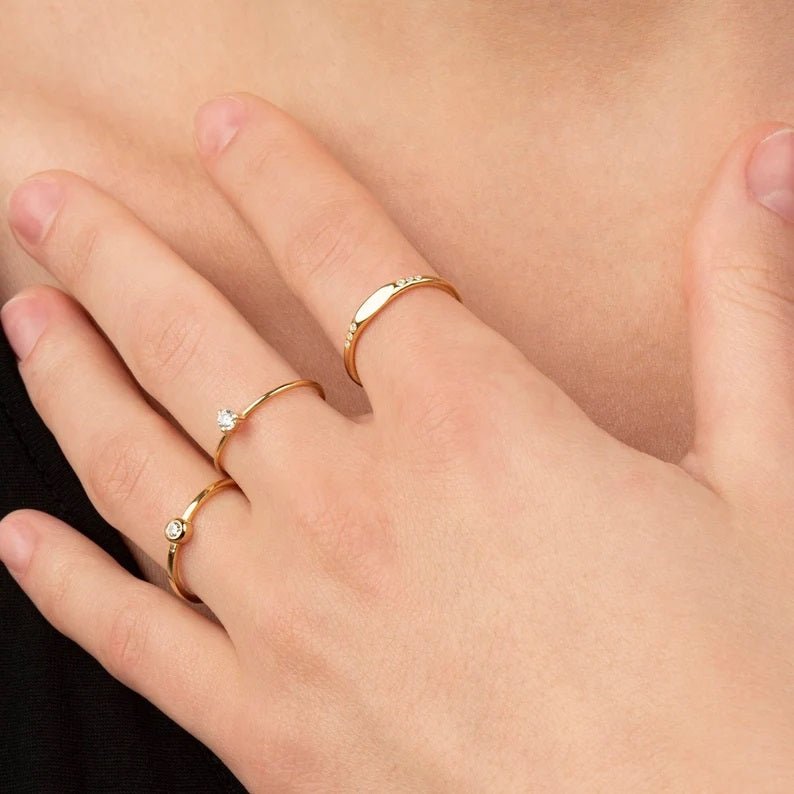
Stacking. You want four, five rings on one finger? That look is gorgeous. And 10k gets you there without the math getting uncomfortable. The impact of a stack comes from mixing profiles and textures, not from the karat stamp on the inside.
First real gold piece. Teenager, college graduate, somebody who has only ever owned plated jewelry and wants to step into solid gold for the first time. 10k is real gold at a price point that makes that step possible.
You have seen both colors and do not care. Some people look at 10k and 14k side by side and the warmth difference does not register for them. If that is you, save the money.
Reasons to Choose 14k
Color matters to you. That slightly richer, deeper gold tone. If you can see it and it makes a difference to you, 14k is worth it.
Sensitive skin. Fewer alloy metals touching your skin all day. If you have reacted to other metals before, 14k reduces that risk.
Heirloom intent. If you are buying a ring that you want to see on your granddaughter's hand forty years from now, 14k carries a little more weight. Not because 10k will not last (that 40 year old ring I mentioned could just as easily have been 10k), but because 14k has traditionally been the standard in fine jewelry across most of the world. And tradition, in this craft, means something.
What to Check Before You Buy Any Gold Ring
Solid vs hollow. Many mass produced gold rings are hollow inside. They look the same from the outside but feel light, dent easily, and can literally crush if you press hard enough. Every ring we make is solid throughout. You feel it the instant you slide it on.
Inside finish. Turn the ring over. Look at the inner band. If it is rough, scratchy, unfinished, that tells you everything about how much attention went into making it. Our interior finish matches our exterior finish. Your skin is touching that surface all day. It matters.
The stamp. 10k, 10kt, or 417. It has to be there. No stamp means ask questions before you buy.
How it feels when you make a fist. Does the profile dig into adjacent fingers? Are edges sharp? Does a stone setting stick up high enough to catch on everything? These are the things that determine whether you actually wear a ring daily or take it off after a week.
Our Collection
We make 17 rings in 10k gold. All shaped in our Athens workshop.
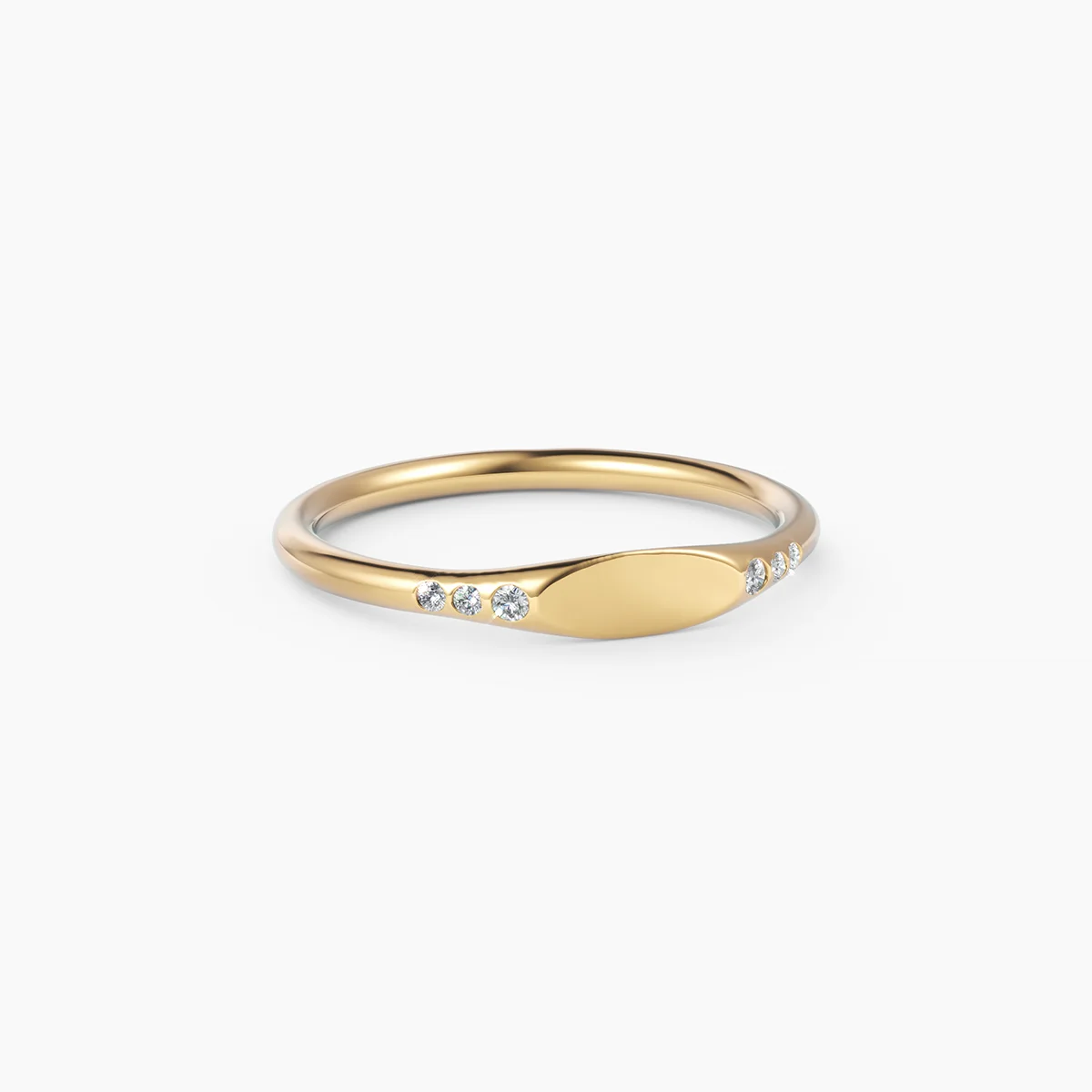
The Three Diamond Band starts at $234. Three small round brilliants on a slim band. The bestseller for stacking because it adds light without adding bulk. Pairs well with two or three plain gold bands.
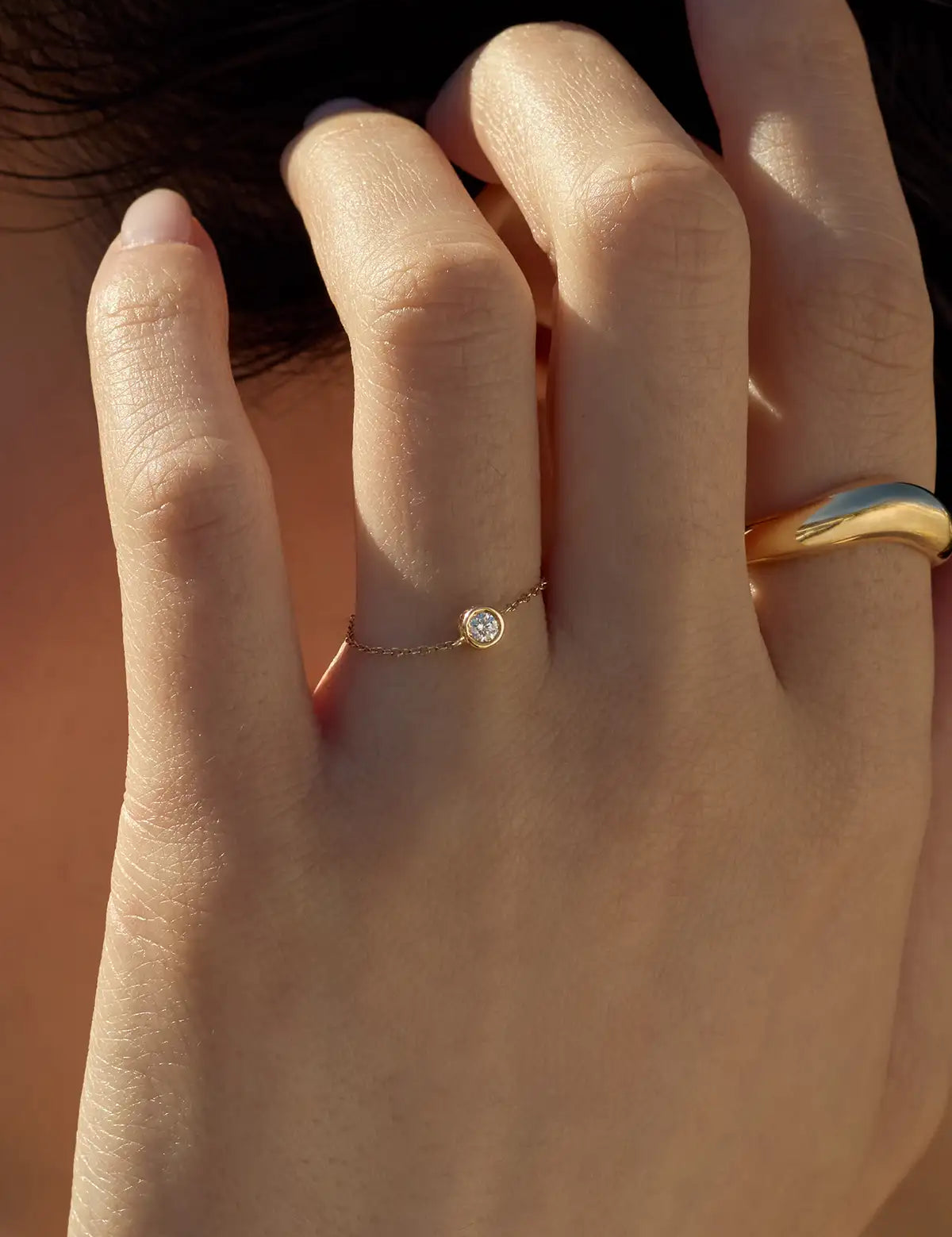
The Éclat Thin Solitaire Diamond Ring is $254. One diamond, one thin band. Probably the most minimal diamond ring you can own. It stacks with everything.
The Tholos Dome Ring at $598 is the one for people who want to feel their ring. Domed, sculptural, solid. You know it is there.
The Kyma Fold Bold Ring at $898 is a statement. Sculptural, architectural, the kind of ring that starts conversations. Not every ring needs to be subtle.
Every single one is also made in 14k gold. Same design, same hands. Your choice is the gold content, nothing else.
Common Questions
Green finger? Not from solid gold. Ever. That is a plated jewelry problem.
Shower safe? Yes. Soap and water cannot hurt solid gold. Keep it away from chlorinated pools for extended periods.
Resizable? Yes. Any jeweler can do it. Solid construction makes it straightforward. (Hollow rings, on the other hand, are often impossible to resize properly.)
Engagement ring material? It works, though 14k is more traditional for engagement. For stackable rings and everyday bands, 10k is a solid choice. Literally.
Cleaning? Warm water. Drop of dish soap. Soft cloth. Fifteen minutes of soaking. Done. Once a year, bring it to a jeweler for a real polish.
See the full 10k gold rings collection, or browse all rings in both karats.
Looking for more than rings? Our 10k gold jewelry collection has necklaces, earrings, and bracelets, all solid 10k, all from our workshop.
We also wrote a deep comparison: 10k vs 14k Gold: Which Is Better for Everyday Jewelry?