




A piercing is a wound the body agrees to keep open. Metal sits inside it, in a warm channel that never fully closes, for as long as the piece is worn. Everything that matters about a pair of earrings follows from that one condition.
Almost nothing written on this subject starts there. It argues about a word instead.
Hypoallergenic is a claim, not a standard
No authority defines the word for jewelry. There is no test a pair of earrings passes, no certificate to hang on the wall, no threshold anyone must clear. A seller writes hypoallergenic on the page because nothing stops them writing it. Europe comes closest to a real rule with a limit on how much nickel a piece may release into skin over time, and even that governs release rate rather than absence. In the United States the word carries no legal weight at all.
So the useful question is never "are these hypoallergenic." The useful question is "what is this metal, all the way through." Those are two different questions, and only one of them has an answer a workshop can give you.
I am not the customer for anything I make. ENEA is women's jewelry and I am a man with thick wrists. So the standard a pair has to clear before it leaves the bench is not my comfort: it is whether the piece belongs on my wife, or on my daughter twenty years from now. Metal is where that test is won or lost, and it is decided long before anyone sees the finished pair.
What the ear is actually reacting to
Nickel, almost always. It is the most common contact allergen in the world and it is diagnosed far more often in women than in men, largely because women get their ears pierced younger and more often. Sweat and body warmth draw ions out of the alloy inside that open channel, and over enough exposures the immune system learns the shape of the metal releasing them. Once it has learned, it rarely unlearns. Treat nickel sensitivity as permanent, because for most people it is.
Cobalt and chromium are the next most common metal allergens after it. Gold itself, the element, is close to inert. It does not corrode, it does not oxidize, and it sheds almost nothing into sweat. That is exactly why gold buried with people four thousand years ago comes out of the ground looking the way it went in. Pure gold is one of the quietest things you can put against skin.
But pure gold is also too soft to hold a diamond, survive a clasp, or keep the shape of a post. So it is mixed. Everything that follows comes out of that one fact.
The 41.5 percent nobody talks about
A piece stamped 14k is 58.5 percent gold by weight. What fills the rest is alloy: silver, copper, zinc, sometimes nickel, sometimes palladium. Two pieces stamped 14k can feel different on the same gram weight, one warmer and softer, one harder and cooler in color, because the recipe for that 41.5 percent varies between workshops. Ours runs more silver than copper, which is why our yellow reads slightly cooler than most mass market 14k. The mix is a decision. A person makes it. And it is that decision, not the karat stamp, that determines whether an ear complains.
This is the part the karat number hides. A stamp tells you how much gold is present. It tells you nothing about the company that gold is keeping. Two workshops can both stamp 14k in good faith and produce metal that behaves completely differently against skin, and the customer has no way to see the difference from a photograph.
10k gold is 41.7 percent gold, which means just under sixty percent of the piece is alloy. More alloy means more of whatever the alloy contains. That is not an argument against 10k, which we make and which holds an edge beautifully. It is an argument for knowing whose 10k you are buying.
Everything we group under hypoallergenic jewelry is solid gold: 10k and 14k, mixed to our own recipe, no plating over anything. Not because solid gold is a marketing position but because it is the only construction where what touches the skin on day one is still what touches the skin in year twenty.
How the mix actually happens
The alloy is not something that arrives in a sealed bag with a specification sheet. It is made. Fine gold goes into the crucible with the alloy metals weighed out beforehand, the torch comes up, and the whole thing goes liquid at a temperature you learn to read by color rather than by gauge. Too hot and the zinc starts to leave; the mix that comes out is not the mix that went in. Too cool and it does not homogenize, and you get a casting with soft spots in it.
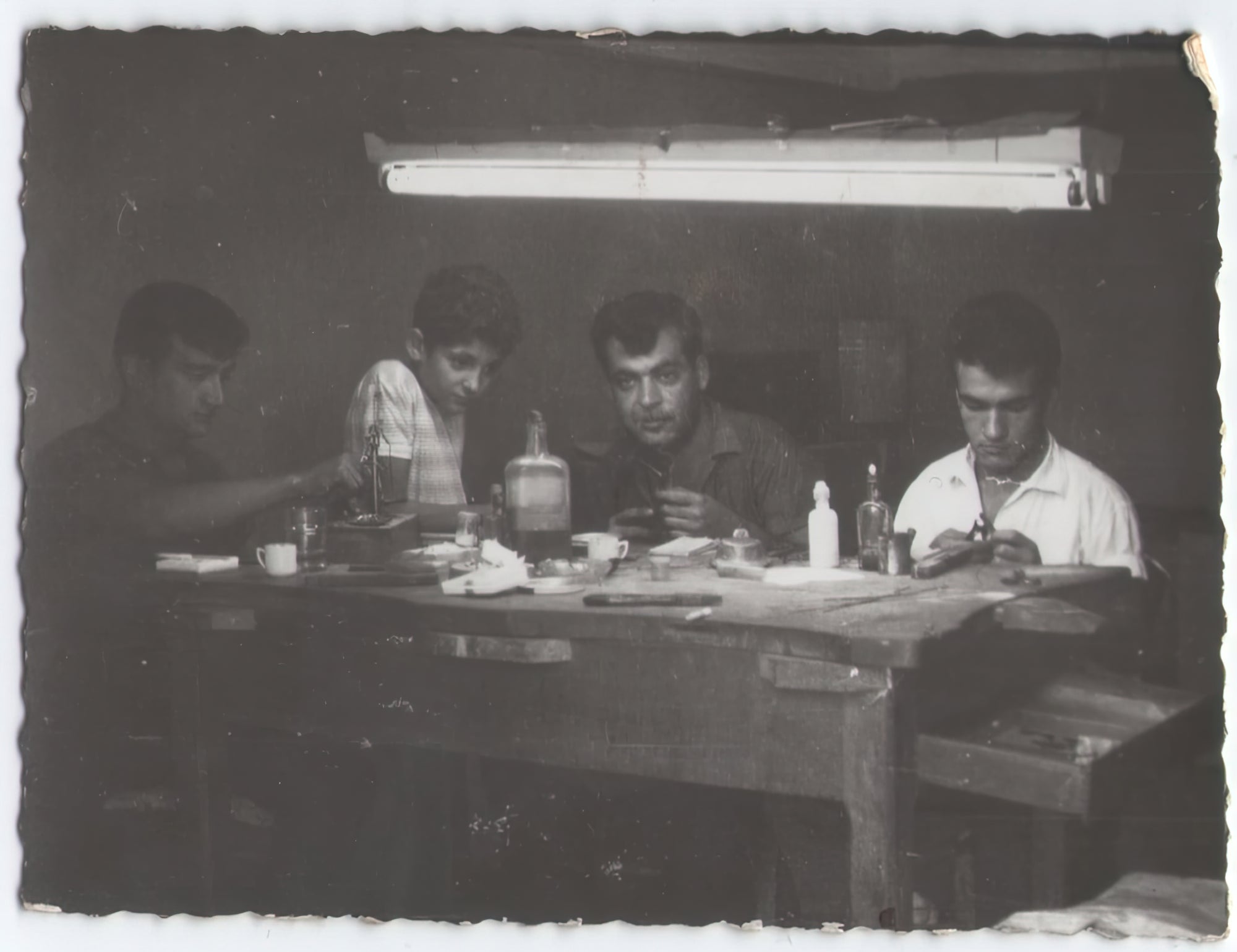
You know the pour is right by how the surface behaves in the last second before it sets, and that is knowledge my father handed over by watching rather than by explaining. That is not romance about old methods. It is the reason a workshop can tell you what is in its metal: because somebody in the building put it there on purpose, in a quantity they chose, on a morning they remember.
A brand that orders finished castings has skipped this entirely. There is nothing dishonest in that; most jewelry in the world is made that way. But it means the answer to "what is in your alloy" has to be requested from a supplier, and suppliers change, and the answer that was true last year is not necessarily true for the batch in the box.
Plated earrings fail on a schedule
Gold plating is a skin of gold, frequently measured in fractions of a micron, deposited over a base metal. Underneath is usually brass, and brass is copper and zinc, with nickel often present in the mix or in the barrier layer beneath the gold. Vermeil is the same idea over sterling silver with a thicker gold layer, which buys time but does not change the physics.
Plating wears at the friction points first. On an earring the friction points are the back of the post, the inside curve of a hoop, and the seam where a hinge closes. Those are precisely the surfaces in constant contact with tissue. When the plating opens, the base metal is inside the piercing, in a warm and damp channel, releasing ions directly into a wound the body keeps open on purpose.
This is why so many people believe they developed an allergy overnight. Nothing changed in the ear. The plating wore through. The pair that was comfortable for eight months and unbearable in the ninth was never comfortable; it was covered.
A solid gold earring has no such deadline. There is no layer to breach. Cut one of ours in half and the cross section is the same metal in the middle as on the surface, which is the entire reason we refuse to plate.
White gold is the question worth asking
Yellow and rose gold are straightforward. White gold is not, and it is the source of most of the confusion on this subject.
Gold is yellow. To make it white you have to alloy it with a whitening metal, and the two traditional choices are nickel and palladium. Nickel produces a hard, bright white and is inexpensive to work with, which is why it is common. Palladium produces a softer, greyer white and costs considerably more. Most white gold is then finished with rhodium plating, which is very rarely reactive on its own, and which wears off the high points over a few years of daily wear. At that moment the alloy underneath is against the skin, and what that alloy contains starts to matter.
If you know your ears react and you are looking at white gold earrings, ask what whitens the gold. A workshop that mixes its own alloy can answer that in one sentence. A brand that buys finished castings from a supplier usually cannot, and the way they handle the question tells you most of what you need to know.
Three things that irritate an ear with no allergy involved
Not every angry ear is an allergic ear. Three mechanical causes account for most of what comes back to us, and none of them have anything to do with metal chemistry.
Weight is the first. A heavy drop pulls downward all day, and the piercing channel slowly elongates under the load. The ear reads that as soreness and the wearer reads it as a reaction. Small earrings and studs avoid the problem entirely, which is why the pairs people wear every single day are almost always the light ones.
Backs are the second. A butterfly back pushed too far up the post compresses the lobe from both sides and traps moisture and skin cells against the metal. The tissue reddens. Nothing is wrong with the alloy. Slide the back down a millimetre and the redness goes in a day.
Cleaning is the third, and it is the one nobody expects. An earring worn continuously for months accumulates sebum and dead skin at the base of the post. That film irritates. Warm water, a soft brush, dry thoroughly, once a week. It sounds too simple to matter. It resolves more complaints than any change of metal.
There is a fourth cause that belongs in a category of its own: a fresh piercing. Skin that was punctured six weeks ago is still building a channel, and almost anything will make it complain, including metal that will be entirely comfortable three months later. If you have reacted to a pair inside the healing window, do not conclude anything about the alloy yet. Wait until the piercing has settled and test again.
When a customer writes to us about an ear that has gone sore, these four are what I ask about before I ask about the metal, and more often than not the answer is somewhere in that list. It is worth going through them yourself before you replace a piece you like.
Where to start if your ears have already reacted
Begin with a stud. A stud has one point of contact and no hinge, no closure, no moving seam where a different metal might be hiding in a spring or a pin. It is the cleanest possible test of whether solid gold agrees with you.
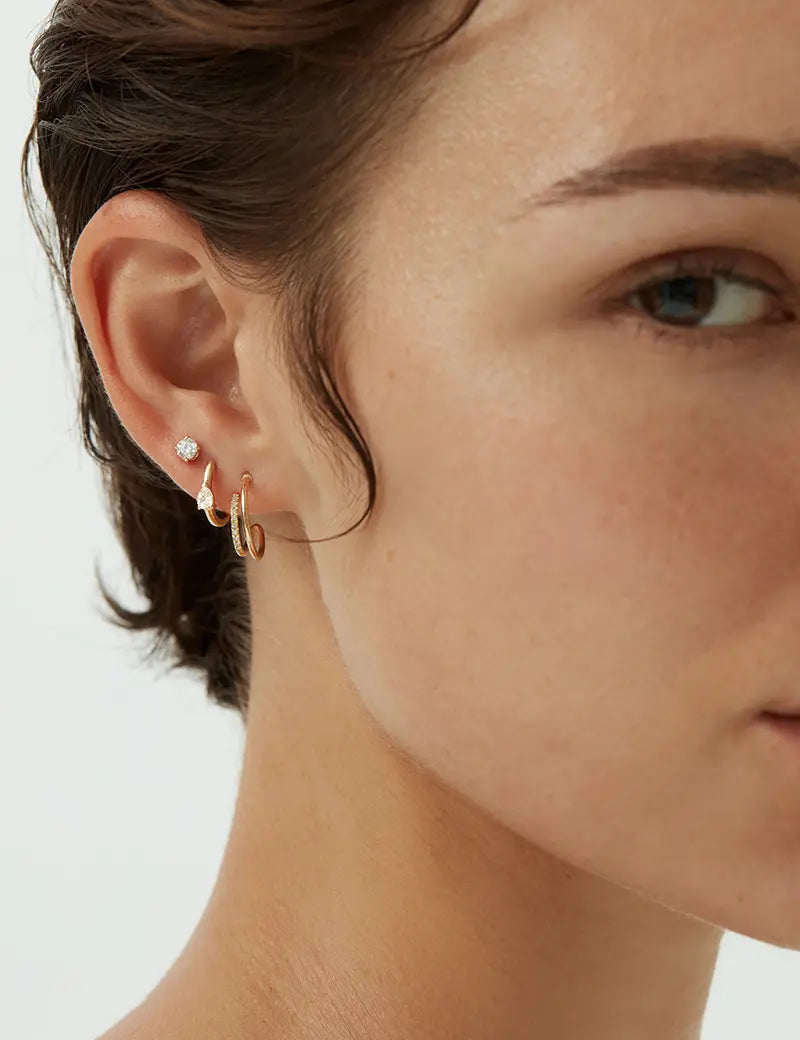
The Gold Knot Stud Earrings are about as simple as a piece of jewelry gets: drawn wire, formed, soldered, polished, nothing else in the piece at all. The Tiny Trio Stud Earrings are the same principle with more presence. If you want a stone, the Éclat Diamond Bezel Studs hold the diamond in a wall of gold rather than in prongs, so the setting itself is a smooth continuous surface with nothing to catch. The Éclat Diamond Stud Earrings and the Pavé Diamond Stud Earrings are the same construction at different scales.
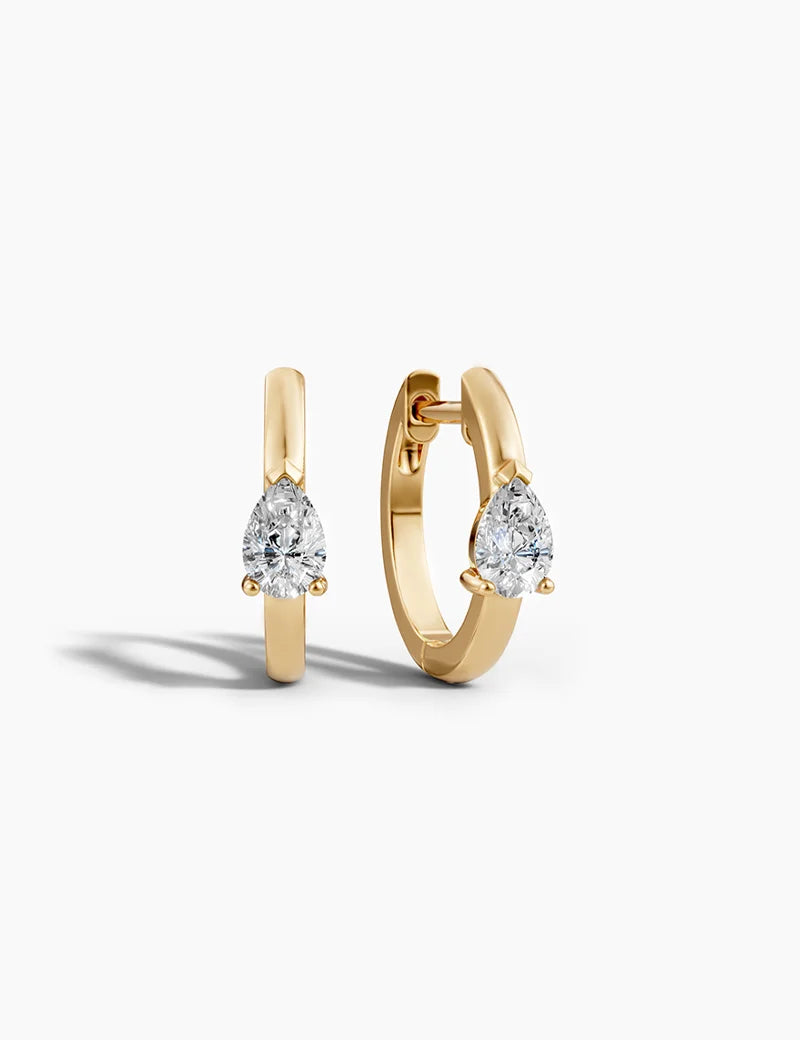
Once a stud has proved itself, hoops are the natural next step, and light ones first. The Classic Tube Hoop Earrings in the small size sit close and weigh almost nothing. The Large Thin Hoop Earrings read much bigger than their weight, which is the whole trick of a well drawn hoop. If you want the diameter without the swing, a huggie is the answer: the Diamond Pavé Huggie Earrings close on the lobe and stay put through a night's sleep. The wider families sit in hoop earrings and huggie earrings.
Cartilage is its own conversation. A helix or a second hole heals slower, sits in tougher tissue, and is far less forgiving of a piece that is not what it claims to be. Everything in helix and cartilage earrings is solid gold for that reason. And if a piercing has closed or you would rather not have one at all, the Minimalist Diamond Ear Cuff sits on the outer edge of the ear with no breach in the skin whatsoever.
A piece meant to stay in
The whole point of getting the metal right is that you stop thinking about it. An earring you have to monitor is an earring you eventually leave in a drawer. The pairs that get worn for twenty years are the ones the body stopped noticing on the second day.
Anything that leaves this bench comes back to it if it needs to, and there is no end date on that. Send a pair in fifteen years with a bent post or a hinge gone loose and it gets fixed. No marketing department wrote that sentence. My grandfather ran the workshop that way, my father after him, and Dimitris and I have never found a reason to change it. If a thing is worth making it is worth keeping in service, and anything that sits in an ear for twenty years has to be built out of something that can stay there without ever asking for attention.
Everything we make sits in the hypoallergenic collection because everything we make is solid gold, mixed here, finished by hand, unplated. That is not a claim about your ears. It is a description of the metal, and the metal is the only part of this we control.