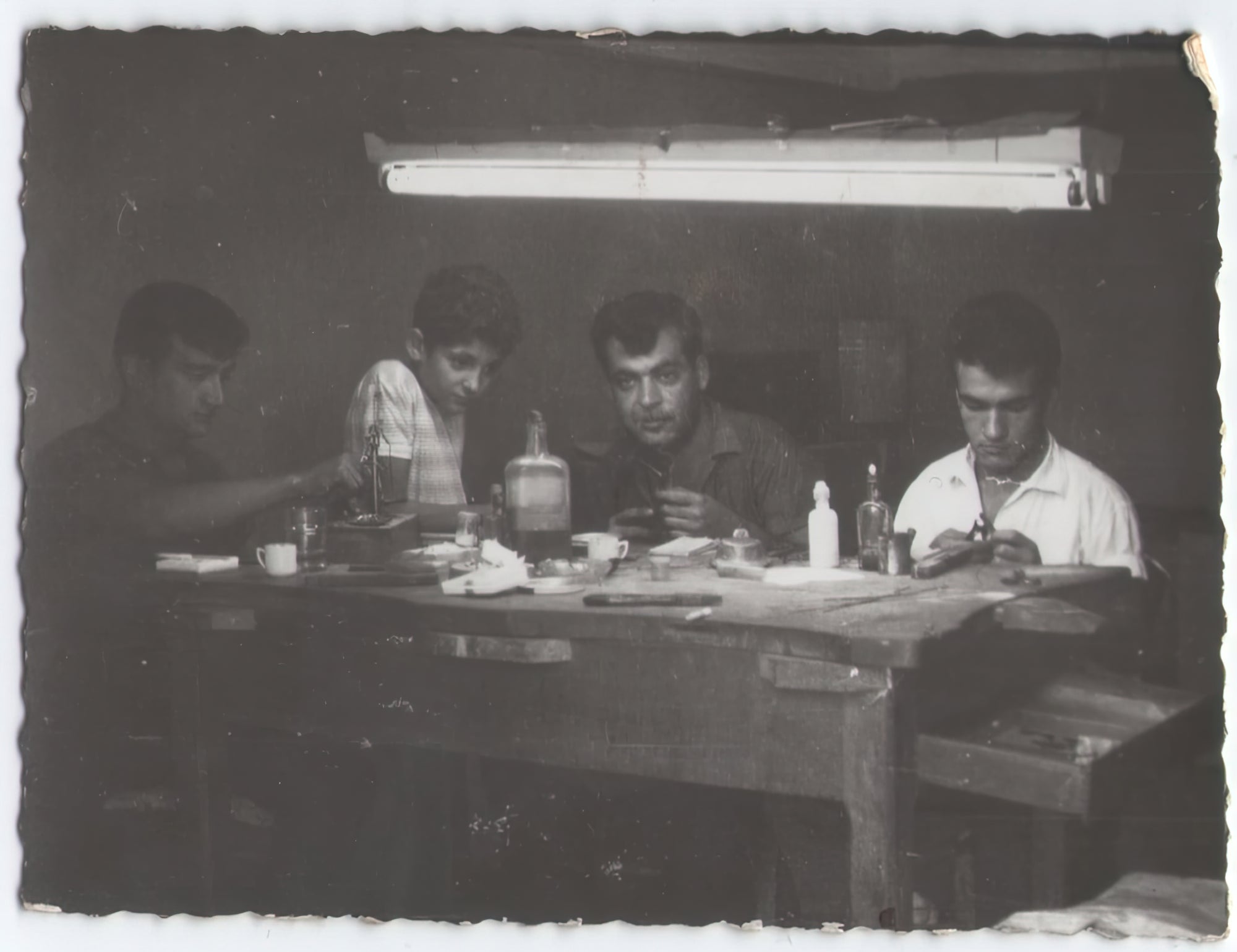






There's a stone on my bench this morning, a round brilliant a little under a quarter carat, and if the week goes the way it should, by Thursday it'll be lying in the hollow of a stranger's collarbone looking like it got there on its own. Nobody will see my work in it. Which sounds like a complaint, but it's the job description. My father taught me to set diamonds by feel, no jig, no machine, just pressure through the fingers, and his father taught him the same way before that, and after three generations of this teaching what you end up with, if everyone did their part, is a necklace that looks like nobody made it.
That's the whole idea of a floating diamond necklace. One stone. A chain fine enough that you lose track of it. A setting cut back so far the diamond seems to sit on the skin by itself. People pick one up in the shop and turn it over, sometimes two or three times, and then they ask me the same question every single time, and I never get tired of it. What keeps it there?
What Makes a Diamond Float
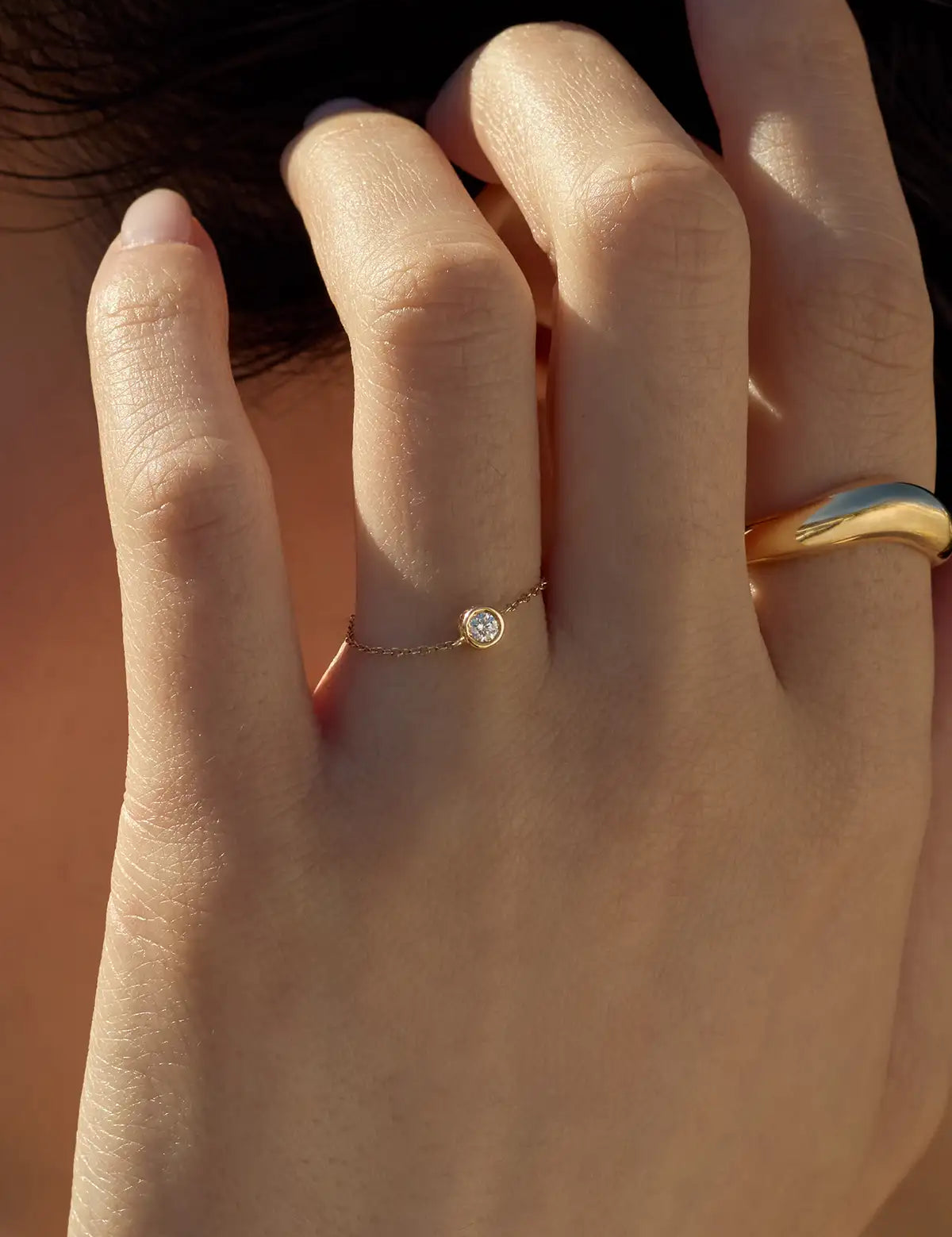
Strange as it sounds, the answer starts with the eye and not with the necklace. The eye goes to metal before it goes to light. If I put a diamond in a tall four prong basket, you'll see the basket first and the stone after. Take the metal away, or hide it well enough, and your mind has nothing to hold onto, so the stone stops reading as jewelry at all. It reads as a drop of water that somehow won't fall. I've watched customers touch one just to check.
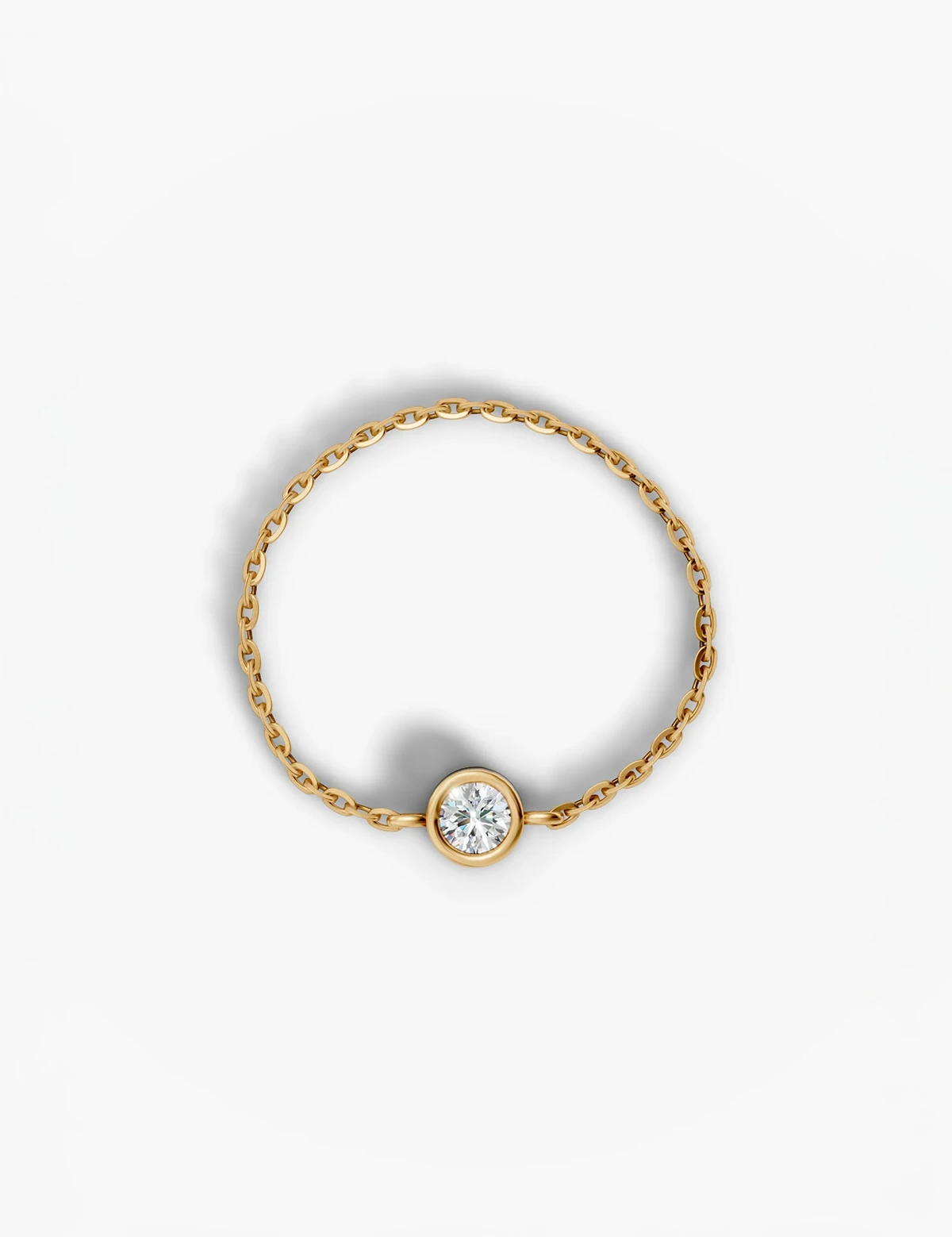
There are three ways I know of to build this without cheating, and I've built all of them more times than I could tell you. You can drill the stone itself and thread it right onto the chain. You can wrap it in a bezel rolled down thin, about the width of a pencil line. Or you can hold it on prongs cut so low they disappear behind the light coming off the stone. Each of these fails in its own particular way when someone gets careless, and that part is worth knowing before you buy anything. Drill the channel a little off center and the stone wobbles. Roll the bezel uneven and one side throws a shadow. Set the prongs half a degree out and the stone tips forward, and now the girdle faces the room, the crown faces the floor, and most of the light goes with it. What still surprises me after all these years is that the woman who buys the piece will never once name the fault. She just feels that something is off, the same way you can tell a picture frame is crooked from across the room without ever pulling out a level.
The other thing, and nobody asks about this one, is that the stone has to stay where you put it. Floating is half the job. Sitting still in the hollow of the collarbone, not sliding sideways, not flipping around to show its back, that's the harder half. Chain weight carries some of it, placement carries the rest, and when either one is wrong the necklace will tell on you within the first hour of wear.
The Drilled Stone
The purest version has no setting at all. We drill a channel through the diamond and run the chain straight through the stone, so gold touches diamond only inside the channel, where nobody can see it. What's left on the skin is a stone and a thread of light.
People assume the diamond must be the easy part of that. It's the opposite. Diamond is the hardest material in the workshop, so the drill only wins the argument because it's dressed in diamond dust, and even then the channel has to run true to five hundredths of a millimetre, which is not a number you hit casually. Any wider and the stone rocks on the chain. A rocking stone catches light unevenly, and here's the strange part, a customer who couldn't tell you what's wrong will still put it back on the counter and reach for a different one. I've watched it happen more than once. The first channel I ever drilled took me the better part of an afternoon, and I can still remember being aware of my own pulse while I did it. It goes faster now. I'm still not casual about it. The Floating Diamond Solitaire Necklace is this construction at its simplest, one drilled stone on a fine cable chain, and the Floating Diamond By The Yard Necklace repeats the same trick down the length of the chain so the light shows up at intervals.
Does the hole weaken the stone? No, and I get asked this every week. A diamond doesn't care about a channel the width of a hair. What it cares about is grain. Every diamond has planes it would rather part along, and a driller who ignores them ends up losing the stone, the hours, and a bit of pride along with it. So we go slow and we keep the stone cool, the way a carpenter saws with the grain instead of fighting it. Slower than I'd like on some mornings. It's still the only way that works.
Worn on the skin, a drilled stone behaves differently from anything else we make. It turns a little as she moves, and since there's no mounting shading it, light gets in from angles a basket would have blocked. The sparkle is less predictable because of that, and more alive. Sooner or later every owner of one tells me about the same moment: someone leaned in, asked what was holding it, and there was nothing to point to.
Bezels and Low Prongs
Not every stone should be drilled, and not every woman wants a stone that turns. The bezel is the older answer, a rim of gold formed by hand around that one particular diamond, holding it flush and protecting the girdle while it's at it. If you roll it heavy you've made a frame. Roll it right and it's barely an outline, and from arm's length it disappears into the stone's own light. When a customer wants the floating look on a necklace she plans to wear hard, every day, through showers and school runs and everything else, the Éclat Diamond Bezel Necklace is the one I put on the counter first. The rest of that family lives in our diamond bezel necklaces collection.
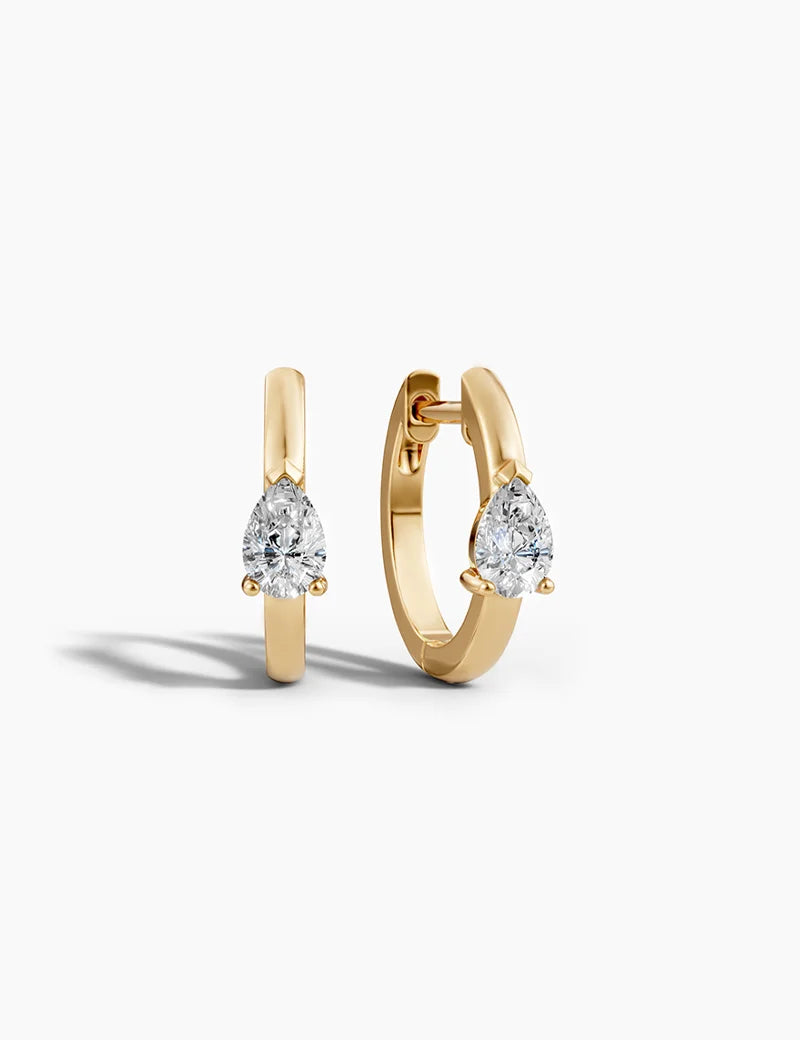
The third route keeps prongs but takes their pride away. Three points of contact, cut low, tucked in behind the spread of the stone where the light hides them. The Teardrop Floating Diamond Necklace hangs a round brilliant this way, with the drop falling into the hollow of the throat. The prongs are there, you'd just have to go hunting for them. A prong you notice is a prong set wrong, and that's about all the theory this trade has ever needed.
Floating or Solitaire
Every floating necklace is a solitaire. Not every solitaire floats. It's worth a minute, because the two carry themselves differently on the same neck.
A classic diamond solitaire necklace presents its stone formally. The four prong martini setting lifts the diamond up off the chest and lets light into the pavilion from underneath, which is why a well set prong solitaire throws more fire than anything else we hang on a chain, and it isn't close. It reads like an occasion even when the occasion is a Tuesday. The Éclat Petite Diamond Solitaire Necklace is that form kept small enough for the dishes and the school run.
A floating stone says the same thing much more quietly. It sits close to the skin, shows no architecture, and looks almost accidental, like the diamond landed there one day and decided to stay. Between the two you have the pear shapes. The Pear Floating Diamond Solitaire Necklace is drilled, and something about that tapered point makes the hovering effect even stranger, while the Éclat Pear-Cut Diamond Necklace gives you the same silhouette in a set form. When a customer is stuck between prong and floating I've learned to ask one question and then stop talking. Do you want the diamond seen from across the room, or noticed only by people who stand close enough to matter? She always knows. Prong if it's the first, floating if it's the second.
Floating or Station
The other decision is one point of light or several. A station necklace spaces its diamonds at measured intervals down the chain, so instead of a single focus you get a line of light that follows the neckline around. The Alinéa Diamond By The Yard Necklace is the classic form of this. And the Floating Diamond Station Necklace is both ideas at the same time, five drilled stones floating at intervals, nothing visible holding any of them. When a visitor asks what this workshop is proudest of, that's the one I take out of the case.
Neither is better. I've made hundreds of both and I couldn't rank them for you. A floating solitaire holds the eye in one place. A station piece walks it along the chain. Different questions, that's all, and only she knows which one she's answering.
Getting the Length Right
The mistake I see most, and I do mean weekly, is length bought off a photograph. A sixteen inch chain sits at the base of one woman's throat and rides above another's collarbone entirely, because collarbones decide where a pendant lands and chains just do what they're told. If the stone is supposed to float in that hollow, someone needs to find out where the hollow actually is before ordering. Sixteen inches suits necklines cut close to the throat. Eighteen drops the stone toward the chest and works with open collars. If she's between the two, we size the chain to the woman and not the other way around, and that's a hill I'll stand on.
Floating stones also turn out to be the easiest diamonds to layer, for a boring mechanical reason: there's no pendant bulk, so a neighboring chain has nothing to grab. A bezel choker worn high, say the Alinéa Diamond Choker Necklace, sits cleanly above a floating solitaire without the two ever meeting. If she wants a third line with a bit more presence below, the Trio Diamond Necklace closes the arrangement without crowding it. The lighter end of all of this lives with our dainty diamond necklaces, which are pieces built to be felt more than announced.
Water, Sleep, Real Life
Three questions come over the counter so reliably I could print them on a card and save everyone the time.
Can she shower with it? Yes. Solid gold doesn't tarnish and it doesn't turn skin green. Those are things plated brass does, not metal that's gold the whole way through. What does happen is soap film, which dulls a diamond's fire over a few weeks, so rinse the stone under warm water once in a while and rub it with a soft cloth. That's the entire maintenance plan. I wish I had something more elaborate to sell you. I don't.
Can she sleep in it? She can, and with a floating construction she probably will, since there's no basket pressing into her skin and nothing tall enough to catch a pillowcase. Sport is the one exception I'd make, and not for the diamond's sake, the diamond fears nothing on this earth. It's the chain, which is fine by design and honest about it.
Will it tangle when she layers it? Less than nearly anything else she owns. Tangles start where pendants swing and where bails hook into a neighbor's links, and a drilled stone threads flat, so there's nothing to catch. This is why floating pieces have quietly turned into the backbone of most of the layered stacks I see walk back into this shop years later. They hold their line and let the louder necklace above them do the arguing.
Choosing the Stone
Size changes what the necklace says, so it helps to think in registers. A tenth of a carat is a whisper, a glint that shows up when the light is right and stays out of the way when it isn't. A quarter carat is steady, visible across a dinner table without asking permission for it. Once you pass half a carat the floating effect starts to turn theatrical, because the mind quietly insists that anything that size ought to have a visible means of support, and the absence becomes the show. None of these is the correct answer, and I'd be suspicious of any goldsmith who told you otherwise. Some pieces dodge the whole question, the Alinéa Two-Sided Diamond Bezel Station Necklace for one, smaller stones repeated down the chain and finished on both faces so there's no wrong way for it to fall.
Every diamond we set is lab grown, and I'd rather say that in the second sentence than bury it in a footnote. Carbon crystallized under pressure. Same structure, same hardness, same light, graded by the same laboratories against the same standards, and the one difference is where the crystal formed. What actually decides whether a floating stone throws light or just sits there is the cut, so the cut is where I allow myself to be unreasonable. I pick every stone before it's drilled or set, and one that cuts corners on light return doesn't reach a chain. Not for a rush order. Not in December.
On the metal, the real question is 10k or 14k, since both are solid the whole way through. 14k runs warmer in color and a touch heavier on the same profile, 10k wears harder for its weight and reads a shade paler. For floating pieces I lean toward 14k, and the reason is the illusion itself: the chain is part of the trick, and a warm line on warm skin reads as almost nothing at all, which is exactly what you want it to read as. Either way, the core matches the surface. This year, and in thirty.
Made to Be Handed Down
Last month a woman came in with a chain her mother bought from us in 2019 and asked to have it sized for her daughter. Six years of daily wear on that chain. No thinning at the clasp, no color shift anywhere, the stone as sure of itself as the day it left this bench. Her mother's piece, about to become her daughter's, and I stood there thinking that I've made the argument for solid gold a thousand different ways over the years and that chain, hanging in the doorway light, made it better than I ever have.
We repair every piece we make. Forever. Bring a floating diamond necklace back in twenty years with a worn clasp or a stretched link and we fix it, because that's how my grandfather ran this workshop, it's how my father ran it, and it's how my brother and I run it now. A piece worth making is a piece worth keeping alive.
Start with the floating diamond necklace collection, or step back and walk the full range of diamond necklaces and compare the settings side by side. Whichever stone she ends up wearing, it was set by hand in Athens, by fingers that learned their pressure from the generation before, and it was built to outlast the reason it was bought.