





I am Laki Tasatzis. I make dainty gold necklaces in our family workshop in Athens. My grandfather started the workshop in 1953. My father grew up in it. I grew up in it. My brother and I run it now.
Dainty gold necklaces are the one piece I have made more of than anything else in twenty years. They sell more than rings, more than bracelets, more than any other necklace style. The reason is simple. A thin gold chain on a collarbone is the most universally wearable piece in fine jewelry. It works on every neck shape, every skin tone, every age, every occasion.
The problem is that almost every dainty gold necklace sold online today is plated brass. The chain wears off in eight weeks, turns the wearer's neck green, and goes in a drawer. Solid gold dainty chains do not do that. They last decades.
This guide is what I want every customer to read before they buy one. The history, the materials, how to spot a real one, how to size it, and what to expect over the years.
If you want to skip ahead to our pieces, our dainty gold necklace collection is here. The rest of this is the goldsmith's view, gathered from three generations of making the same kind of piece.
The Thin Gold Chain Has a Longer History Than You Think
A dainty gold chain is not a 2020 trend. It is one of the oldest forms of jewelry on the human body, and the form has barely changed in three thousand years.
The earliest gold chains we have evidence of are from Egypt around 3000 BCE. Egyptian goldsmiths drew gold wire by pulling it through holes in stone, twisting and looping the wire into thin chains, and finishing the chain with a simple hook clasp. Some of those chains, recovered from tombs, are recognizable as the same form we make today.
In Greece, where my workshop has stood for three generations, thin gold chains were made by the Mycenaeans in the Bronze Age and by classical Greek goldsmiths from the fifth century BCE forward. Greek women wore them daily, often layered with longer pieces. The form was passed from mother to daughter as a coming of age piece.
When I was a kid in our workshop in Athens, I watched my grandfather draw thin gold wire by hand. He did it the same way the Egyptians did, just with a steel drawplate instead of a stone one. He pulled the wire from a thicker rod through progressively smaller holes until the wire was the right thickness for a chain. Then he twisted, looped, soldered, and the chain was done. The technique is older than every empire.
What I am saying is, when you buy a dainty gold necklace, you are buying a form that women have worn continuously for five thousand years. It will not go out of style because it has never gone out of style anywhere on the Mediterranean.
What Dainty Actually Means
The word dainty gets thrown around online without precision. In the workshop, dainty has a specific meaning. The chain thickness is between 0.8mm and 1.4mm. Anything thinner than 0.8mm is too fragile for daily wear. Anything thicker than 1.4mm reads as a regular chain, not a dainty one.
The total weight of a dainty chain in 14k gold is usually between 1.5 grams and 3 grams. A featherweight chain at 1.5 grams is barely noticeable on the skin. A 3 gram chain has a soft drape and feels like a real piece, but still reads as dainty.
The chain construction matters too. The most common dainty chain styles are cable (round flat links), Figaro (alternating long and short links), box (square links), and snake (smooth flexible). Each one wears slightly differently on the skin. The cable chain is the workhorse. It is what my grandmother wore daily for forty years. The snake chain has a smoother feel against the skin but is harder to repair if a link breaks.
For a first dainty chain, my recommendation is a 1.0mm to 1.2mm cable chain in 14k gold, around 16 to 18 inches long, with a small spring ring clasp. That is the form most women wear daily without thinking about it.
How to Tell a Real Solid Gold Necklace From a Plated One
If a gold necklace costs less than ninety dollars, it is plated. Solid gold has a hard floor on price set by the gold market. Right now, even the smallest dainty 14k chain (1.5 grams, 16 inches) carries about 90 dollars of pure gold weight before any labor. A finished, branded, retail ready chain at that weight starts at 150 to 200 dollars minimum from a real maker.
If a listing says gold tone, 18k gold plated, vermeil, gold filled, or gold over silver, it is plated. The gold layer is between 0.5 microns (cheapest plating) and 5 microns (vermeil). The base metal underneath is brass, copper, or silver. Brass is the one that reacts with sweat and turns skin green. Vermeil is solid silver underneath, which does not turn skin green but the gold layer still wears off.
Plating wears fastest at points of friction. On a dainty necklace, that is wherever the clasp lands and wherever the chain crosses on itself when you sleep. Even a high quality plating will start showing the base metal within six to twelve months of daily wear. In the summer, sweat and salt accelerate the process.
Solid gold is different. There is no plating to wear off because solid gold is gold all the way through. It does not change color, does not turn skin any color, and does not corrode. The only thing that happens to solid gold over years of wear is that the surface develops a slightly soft glow as micro scratches catch and reflect light differently. Some people prefer the new shine. Some prefer the soft patina of an old piece. Either way, it is the same gold.
The buyer test takes thirty seconds. Look for a stamp inside the clasp tab or on a small tag at the chain. Real gold has one of these marks: 14K, 14kt, 585 (the European mark for 14k, meaning 58.5 percent pure gold), 10K, or 417. If the stamp says GP, GF, GE, EP, or vermeil, it is plated. If there is no stamp at all, assume plated. Real gold is always stamped because the maker has nothing to hide.
The other test is the listing language itself. Real solid gold listings say solid 14k gold or solid 10k gold. Plated listings dance around the word solid. Watch for hedging phrases like gold tone finish, real gold layer, premium plating. Anything that is not solid gold is not solid gold.
14k or 10k for a Dainty Chain
We make dainty chains in both 14k and 10k. Neither is better. They are different choices for different purposes.
14k gold is 58.5 percent pure gold. The remaining 41.5 percent is alloy, mostly silver and copper for warmth. 14k is the global standard for fine jewelry. The color is a warm, soft yellow. It is hard enough to resist most daily wear but soft enough that a goldsmith can repair or resize it without trouble. For a dainty chain that will sit on the collarbone every day for ten years, 14k is the standard answer.
10k gold is 41.7 percent pure gold. The rest is alloy. 10k is harder than 14k because there is more alloy and less pure gold. The color is slightly cooler, more neutral. 10k costs less because it contains less gold by weight. For a chain that gets caught on shirts and bags every day, 10k holds polish a little longer.
Both are real solid gold. Both are stamped. Both can be worn in water. Both pass through US customs as fine jewelry. The choice between them is about how you wear it. If your dainty chain stays on through showers, beaches, and sleep, 10k is the practical choice. If you take it off at night and wear it lightly, 14k feels warmer and pairs better with most other gold pieces in a layered stack.
If you want the deeper version of the alloy comparison, our 10k vs 14k gold guide has the full goldsmith's view.
The Length Question
Dainty chains come in standard lengths from 14 inches (choker) to 24 inches (longest layering chain). The most common lengths and where they sit on the body:
- 14 inches: choker, sits at the base of the neck. Best for petite frames or layering as the top chain in a stack.
- 16 inches: just below the collarbone. The most universally flattering length and the one we sell most.
- 18 inches: at the collarbone or just below, depending on neck length. Pairs well with shirts that have an open collar.
- 20 inches: at the top of the breastbone. Reads more relaxed, less formal.
- 22 to 24 inches: at mid breastbone or longer. Used mostly for layering with shorter chains.
When a customer cannot decide between 16 and 18, my recommendation is to go with 18. It is easier to shorten a chain (we add a slide adjustment for the difference) than to lengthen one. A 16 inch chain on a tall frame can read tight. An 18 inch chain on a petite frame falls in a flattering position.
If you are buying for someone else and you do not know their neck size, 18 inches works for almost every adult woman. We have shipped thousands of 18 inch chains and the return rate for sizing is under one percent.
Layering a Dainty Chain With Other Pieces
A dainty chain is the foundation of a layered stack. It is the piece that anchors everything else. For a complete take on layering, our layering gold necklaces guide goes into the rules in detail.
The short version for dainty chains specifically: a single dainty chain works alone. Two dainty chains in different lengths (16 plus 18) work together. Three dainty chains starts to crowd the line and lose the quiet effect. If you want to layer more than two, mix a dainty chain with a slightly thicker chain or a pendant piece, so the visual hierarchy is clear.
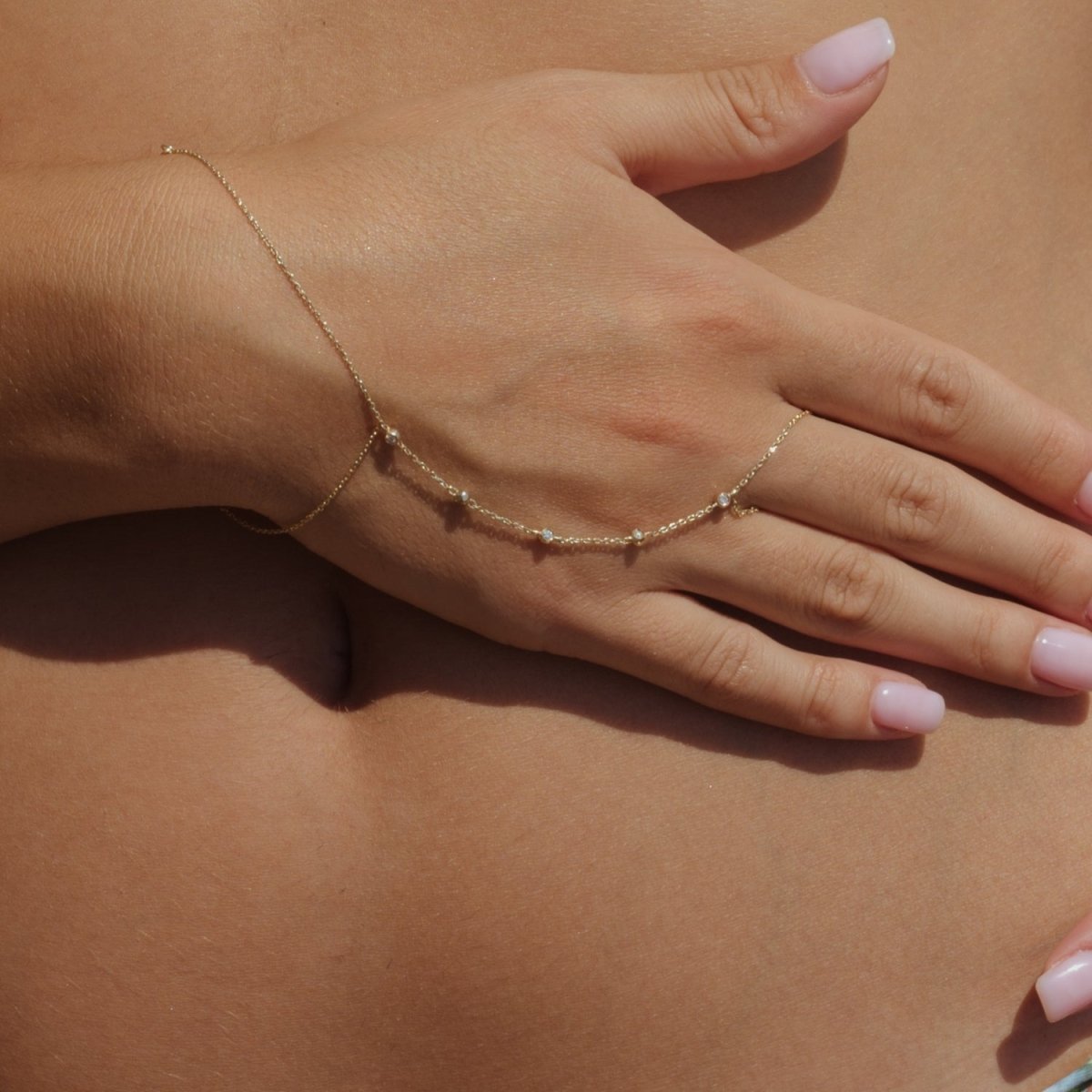
The dainty chain pairs especially well with a single diamond solitaire pendant, with a station necklace layered slightly longer, or with a hand chain bracelet on the wrist for a fully Mediterranean look (we wrote about hand chains here).
Care, Which Is Almost Nothing
Solid gold does not tarnish. It does not need polish. It does not need ultrasonic cleaning. It does not need silver dip. The simplest care routine is the right one.
Once a month, drop the chain in a bowl of warm water with a single drop of dish soap. Leave it for five minutes. Scrub gently with a soft toothbrush along the links. Rinse under tap water. Pat dry with a soft cloth. That is it. The chain looks new again.
Things to actually avoid:
- Storing the chain tangled in a pile with other jewelry. Knotted chains are a real problem and untangling them often breaks links. Hang each chain separately or store flat in a cloth pouch.
- Pulling on the chain when putting on a sweater. The chain catches on the fabric and snaps the weakest link. Take the chain off when changing clothes that go over your head.
- Letting the chain sit in a perfume cloud or hairspray cloud. The chemicals do not damage the gold itself but they can dull the polish and require more frequent cleaning.
If a link breaks, send the piece back to us. We repair our pieces for life. A broken link on a dainty chain is a five minute solder job. The clasp is replaceable. The piece is the same piece you owned the day before.
The customer who bought our first dainty cable chain in 2018 still wears it daily. She has had two clasp replacements (clasps wear faster than chains do, because they are mechanical pieces). The chain itself is original. Eight years, daily wear, no patina problems.
The Diamond Variation
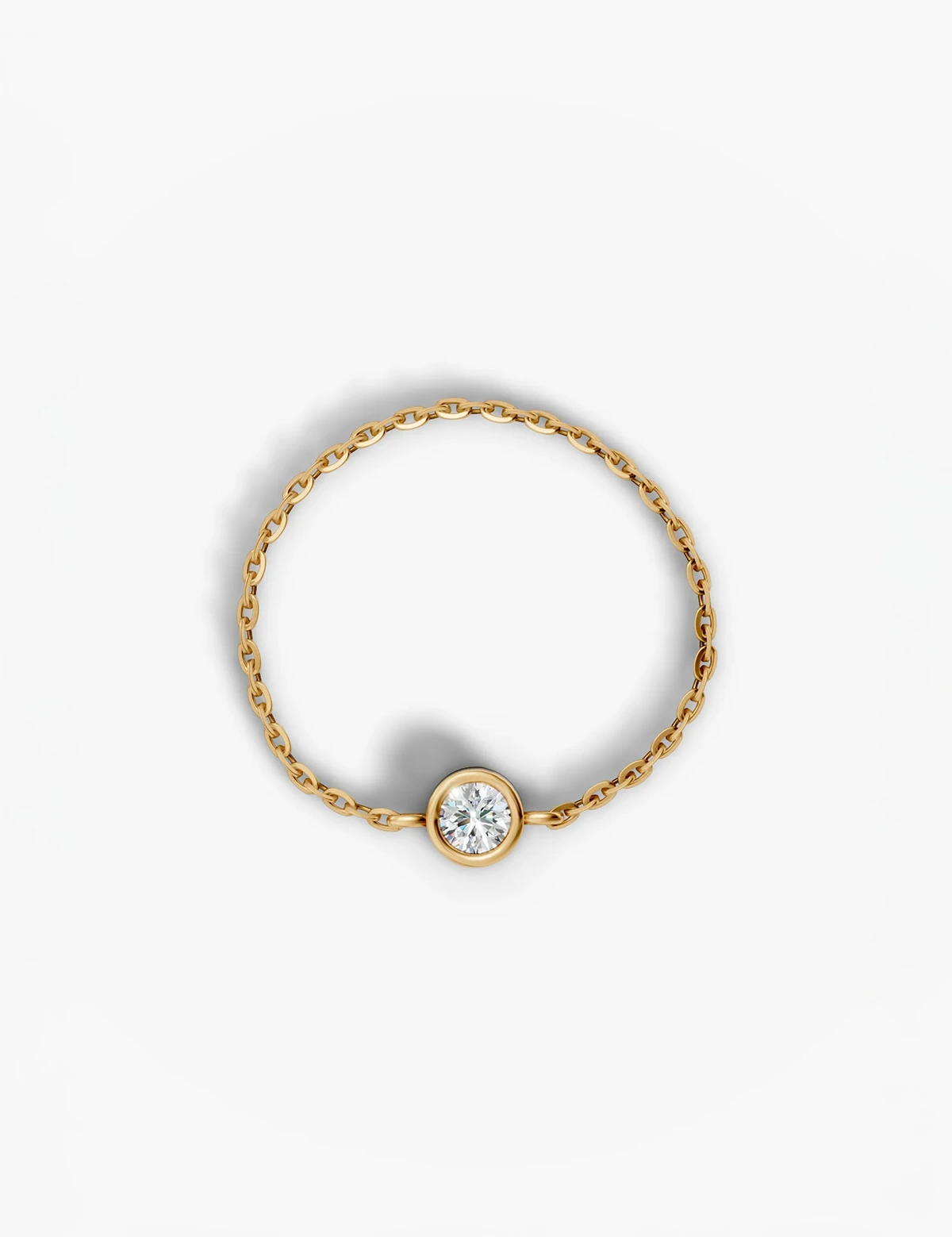
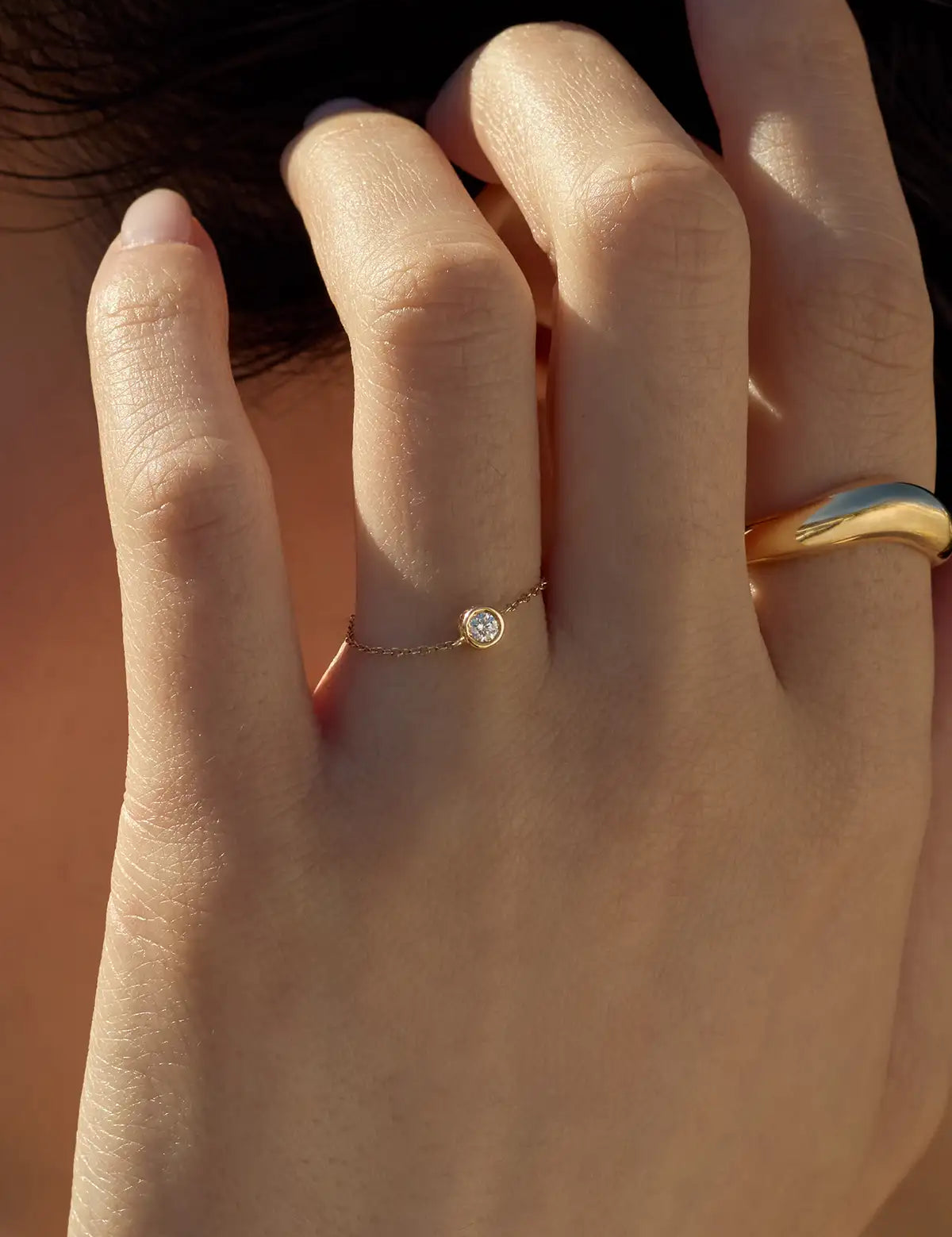
Some of our customers want a dainty chain that does a little more than sit plain on the skin. We make several variations with lab grown diamonds set as small bezels along the chain or as a single floating stone at the front.
The diamonds are real diamonds, just made in a lab instead of mined. Same chemical structure, same hardness, same brilliance. They cost about a third of mined diamonds for reasons that have nothing to do with quality. We use them because the math works out for our customers without compromising on what the stone actually is.
A dainty chain with a single 0.05ct floating diamond at the front is the piece I recommend most often as a daily wear with a small upgrade. The diamond catches light at the collarbone when the head turns. It reads as solid 14k gold with a small bright point, not as a flashy diamond piece. It is the difference between a chain you take off for nice occasions and one you wear forever.
If you want the deeper take on lab grown vs natural, our natural vs lab grown diamonds guide has the full goldsmith's perspective.
What to Look For When You Buy
If you are buying a dainty gold necklace from any maker, these are the questions that separate a piece worth keeping from one that ends up in a drawer:
- Is it solid gold or plated? The listing must say solid 14k gold or solid 10k gold. If it says gold filled, vermeil, gold plated, or gold tone, it is plated. The piece will not last the way solid gold does.
- Is it stamped? Real gold is always stamped. 14K, 585, 10K, or 417 inside the clasp or on a tag. No stamp, no buy.
- Who made it? A maker who can tell you the country, the workshop, the goldsmith is a maker who stands behind the piece. A vague designed in California, made overseas is a flag.
- What is the chain weight? A dainty 14k chain at 16 to 18 inches should weigh between 1.5 and 3 grams. Below 1.5 grams the chain is too thin to last. Above 3 grams it is not really dainty.
- What is the repair policy? Will the maker repair a broken link? Replace a clasp? If the answer is we do not offer repairs, the piece is designed to be replaced, not kept.
A solid gold dainty chain made correctly is a piece you can wear for thirty years. We have customers wearing pieces from 2018 daily. The chain has not changed. The clasp has been replaced once or twice. That is a piece worth buying.
Frequently Asked Questions
How much does a real dainty gold necklace cost?
A solid 14k gold dainty chain at 16 to 18 inches typically runs between 200 and 450 dollars depending on chain weight and the maker. A solid 10k version of the same piece runs between 150 and 300 dollars. A piece with a small diamond at the front runs between 300 and 700 dollars. Plated versions cost less but they are a different product entirely.
Can I shower with a dainty gold necklace?
Yes, if it is solid gold. Solid 10k and 14k gold are not affected by water, soap, shampoo, or chlorine. Plated jewelry is, and showering with a plated piece will accelerate the wear of the plating. If your piece is solid gold and stamped 14K or 585 or 10K or 417, you can shower with it on.
Will a real gold necklace turn my skin green?
No. Solid 14k and 10k gold are too high in gold content to react with skin chemistry. If your skin is turning green under a gold necklace, the piece is plated brass and the plating has worn through to the brass underneath. Brass reacts with sweat, copper transfers to the skin, and the green tint appears. Solid gold does not do that.
What length should I get?
For most adult women, 18 inches is the safest answer. It sits at or just below the collarbone on most necks and works with most necklines. If you are petite or want the chain higher on the throat, 16 inches. If you want a longer drape into the breastbone, 20 to 22 inches.
Can I wear a dainty gold necklace every day?
Yes. Solid gold dainty chains are built for daily wear. The customer who started us on dainty chains in 2018 has worn hers daily for over six years. Take it off only for activities involving heavy fabric over the head (changing sweaters, dressing for sports) or when working with abrasive materials.
What is the difference between dainty and delicate?
In the workshop, dainty refers to the size of the chain (thin, low weight) and delicate refers to the construction (fine links, light gauge wire). A dainty chain is almost always also delicate. The terms are used interchangeably in the trade.
The dainty gold necklace is one of the oldest pieces of jewelry on the human body. We have been making them in our Athens workshop for three generations. Every chain we make is solid 14k or 10k gold, stamped, and built to be worn daily for decades.
Browse our dainty gold necklace collection, explore our solid gold jewelry, or read about our family workshop on our About page.
The piece your daughter inherits should be made by a workshop that has done this for three generations.