




In our Athens workshop the torch runs from morning to night. Even in summer the bench radiates heat. My brother Dimitris is finishing a pair of small gold studs a customer ordered last week.
I was thirteen when my father let me finish a piece on my own, start to finish. It was a pair of small gold studs for a girl who lived in our neighborhood. The studs were imperfect, asymmetric by half a millimeter, and my father caught it before they shipped and made me redo them. I redid them. They shipped. Twenty seven years later that woman, who was a girl then, sent the pair back to be polished. They are still in our records. They are still on her ears.
That pair of studs is why I write this post with some authority. Stud earrings are the most underrated piece in fine jewelry. They are the first solid gold piece most women buy, the last one they ever take off, and the one most likely to be passed to a daughter. They are also the piece I have made more of than anything else in twenty years, by a wide margin.
This post is what I want every customer to read before buying their first pair. Our gold stud earrings collection is here if you want to skip to the pieces. The rest of this is the goldsmith's view, gathered from three generations of making the same form.
The Stud Earring Has the Longest Continuous History of Any Jewelry
A gold stud earring is not a modern invention. It is one of the oldest forms of jewelry on the human body, and the form has barely changed in five thousand years.
The earliest gold studs we have evidence of come from royal tombs in Mesopotamia dating to 2600 BCE. Egyptian goldsmiths refined the form, casting small gold beads and bezels around colored stones. Greek and Minoan goldsmiths from the Bronze Age forward perfected the round gold stud with a back post and butterfly back, which is essentially the same construction we use today.
When I was a kid in our workshop in Athens, I watched my grandfather draw the thin gold wire that becomes the post on a stud earring. He did it the same way Egyptian goldsmiths did three thousand years ago, just with a steel drawplate instead of a stone one. He pulled the wire from a thicker rod through progressively smaller holes until the wire was 0.8 millimeters thick, the standard post diameter for fine jewelry. That technique is older than every empire that has ever existed in the Mediterranean.
What I am saying is, when you buy a pair of gold studs, you are buying a form that women have worn continuously for five thousand years. It does not go out of style because it has never gone out of style anywhere on the Mediterranean coast.
What Solid Gold Actually Means for Studs
Here is the truth most stud earring sellers will not tell you: the difference in price between a $30 pair of gold studs from a mass market chain and a $250 pair of solid gold studs from a real workshop is not markup. It is materials.
A gold stud earring at the $30 price point is plated brass. The gold layer is between 0.5 microns and 5 microns thick. The base metal underneath is brass, copper, or silver. Brass is what reacts with sweat and turns the earlobe slightly green or itchy. Most women blame their skin. The skin is fine. The earring is plated.
We make in solid 14k and solid 10k gold. Solid means gold all the way through. There is no plating to wear off because there is no plating. Cut a real stud earring in half (please do not, but theoretically) and you see gold from one side to the other. The piece does not change color over twenty years of daily wear, does not react with skin, does not need replacement.
Our gold stud earrings cost more than the studs sold at Pandora or Kay because their studs are plated brass and ours are solid gold. That is not a marketing claim. The price difference is the cost of real gold versus plating, plus the hand labor of a workshop versus a factory line. If you buy a pair of solid gold studs in 2026, you are buying a piece that will be a pair of solid gold studs in 2046. The plated version will be brass with worn gold by next year.
The buyer test takes thirty seconds. Real gold has a stamp on the post or the back: 14K, 14kt, 585, 10K, or 417. If the stamp says GP, GF, GE, vermeil, or nothing at all, it is plated. Real gold is always stamped because the maker has nothing to hide.
14k or 10k for Stud Earrings Specifically
We make stud earrings in both 14k gold and 10k gold. Neither is better. They are different choices for different purposes.
14k gold is 58.5 percent pure gold. The remaining 41.5 percent is alloy, mostly silver and copper. 14k is the global standard for fine jewelry. It is soft enough to feel warm on the skin and hard enough to resist daily wear damage.
10k gold is 41.7 percent pure gold. The rest is alloy. 10k is harder than 14k and costs less because it contains less gold by weight. The color is slightly cooler, slightly more neutral.
For studs specifically, here is a detail most customers do not know: two pairs of 14k gold studs from two different workshops can feel different on the ears. That is because the 41.5 percent that is not gold is alloy, and the alloy recipe varies. Our alloy uses more silver than copper, which gives our 14k a slightly cooler color and a softer hand. Some other workshops use more copper, which gives their 14k a warmer red yellow tint and a harder feel. Same stamp. Different feel. Our 14k gold earrings guide goes deeper into the weight and balance side of the question.
If you have ever held a piece of 14k that felt different from another piece of 14k, you were not imagining it. The alloy mix matters as much as the karat number. Our 10k vs 14k gold guide covers the full comparison.
For a daily wear pair of studs, my recommendation is 14k in our alloy mix because the cooler color reads more refined under most skin tones. For someone who is rough on their jewelry (catches it on sweaters, sleeps on it, swims daily) 10k holds polish longer because it is harder.
The Back Matters More Than the Front
This is the part of stud earring buying nobody talks about. The back is more important than the front.
A solid gold stud with a plated brass back is not a solid gold stud. The back is the part that touches the skin all day every day. If the back oxidizes or turns the lobe green, the earring fails. Cheap workshops put real gold in the visible front and plated brass in the back to save five dollars per pair. Do not buy these.
Every back we make is the same gold as the front. If the front is 14k, the back is 14k. If the front is 10k, the back is 10k. Same alloy, same stamp.
The three main back styles, and which to choose:
Butterfly back (the most common). Two metal wings that grip the post by friction. Easy to put on, easy to lose if the wings loosen over years. The standard back for most daily wear.
Screw back. A threaded post and a back that screws on. Cannot fall off. Slightly slower to put on. Best for sleeping with earrings in, for traveling, for high stake pieces like diamond studs. Our diamond studs all come with screw backs as standard.
Latch back (also called locking back). A spring loaded mechanism that clicks open and shut. The most secure back of all. We use it on our heaviest studs (8mm and up) because the weight of the stud needs a secure back.
If you are buying for daily wear with regular size studs, butterfly back is fine. If you are buying diamond studs or anything you want to never lose, ask for screw back or latch back.
Size Matters Too (the Mistake Most Buyers Make)
The number one mistake I see customers make with stud earrings is buying the wrong size. Stud size is measured in millimeters across the visible front of the earring. The common sizes:
- 3mm: very small, reads as a tiny gold dot. Best for the second piercing in a stack or for very minimalist style.
- 4mm: small, classic everyday. The most universally worn size and the one we sell most.
- 5mm: medium small, slightly more visible. Pairs well with most face shapes.
- 6mm: medium, more present. Reads as a real earring without being statement.
- 8mm: medium large, statement. Best for larger ear lobes or for someone who wants the stud to be seen.
- 10mm and up: large, statement only. Not daily wear sizing.
When a customer cannot decide, my recommendation is 4mm or 5mm. They sit in the sweet spot where the earring is visible without being demanding. Anything below 3mm gets lost on most ear lobes. Anything above 8mm reads as occasion wear, not daily wear.
For a first solid gold stud, 4mm in 14k gold is the answer for almost every adult woman. For something completely different in 10k gold, see our 10k gold rings guide. We have shipped thousands of 4mm 14k studs and the return rate for sizing is under one percent.
The Diamond Stud Variation
A significant share of our stud earring orders are diamond studs. We make several variations using lab grown diamonds set in 14k gold bezels or prongs.
The diamonds are real diamonds, just made in a lab instead of mined. Same chemical structure, same hardness, same brilliance. They cost about a third of mined diamonds for reasons that have nothing to do with quality.
Diamond stud sizing is measured in total carat weight per pair (TCW). The common sizes:
- 0.10 TCW (0.05ct each side): very small, soft sparkle. Good for everyday.
- 0.20 TCW (0.10ct each side): small, clean sparkle. The everyday standard.
- 0.50 TCW (0.25ct each side): medium, noticeable sparkle. Good for occasion wear or as a gift piece.
- 1.00 TCW (0.50ct each side): medium large, real statement. The classic diamond studs people picture.
- 2.00 TCW (1.00ct each side): large, formal occasion only.
For a first pair of diamond studs that gets worn daily, 0.20 to 0.50 TCW is the right range. Smaller reads as too modest, larger reads as occasion wear.
The setting matters as much as the stone. My father taught me to set a diamond by feel, not by jig. Each bezel and each prong is pressed into place by hand, by the same fingers that have set thousands of stones before this one. For more on diamond styles beyond studs, our diamond necklace styles guide covers every form we make. A machine set diamond looks fine on day one. A hand set diamond reads differently because the metal sits against the stone with a tension a machine cannot replicate.
We use bezel settings for daily wear because the bezel protects the stone from catching on hair, sweaters, and the inside of bags. Prong settings let more light into the stone (more sparkle) but the prongs catch on fabric more easily. For a piece you will wear daily for years, bezel is the practical choice. For a piece for special occasions, prongs.
If you want more on the lab grown question, our natural vs lab grown diamonds guide has the full goldsmith's view.
A Note on Pairing Studs With Hoops
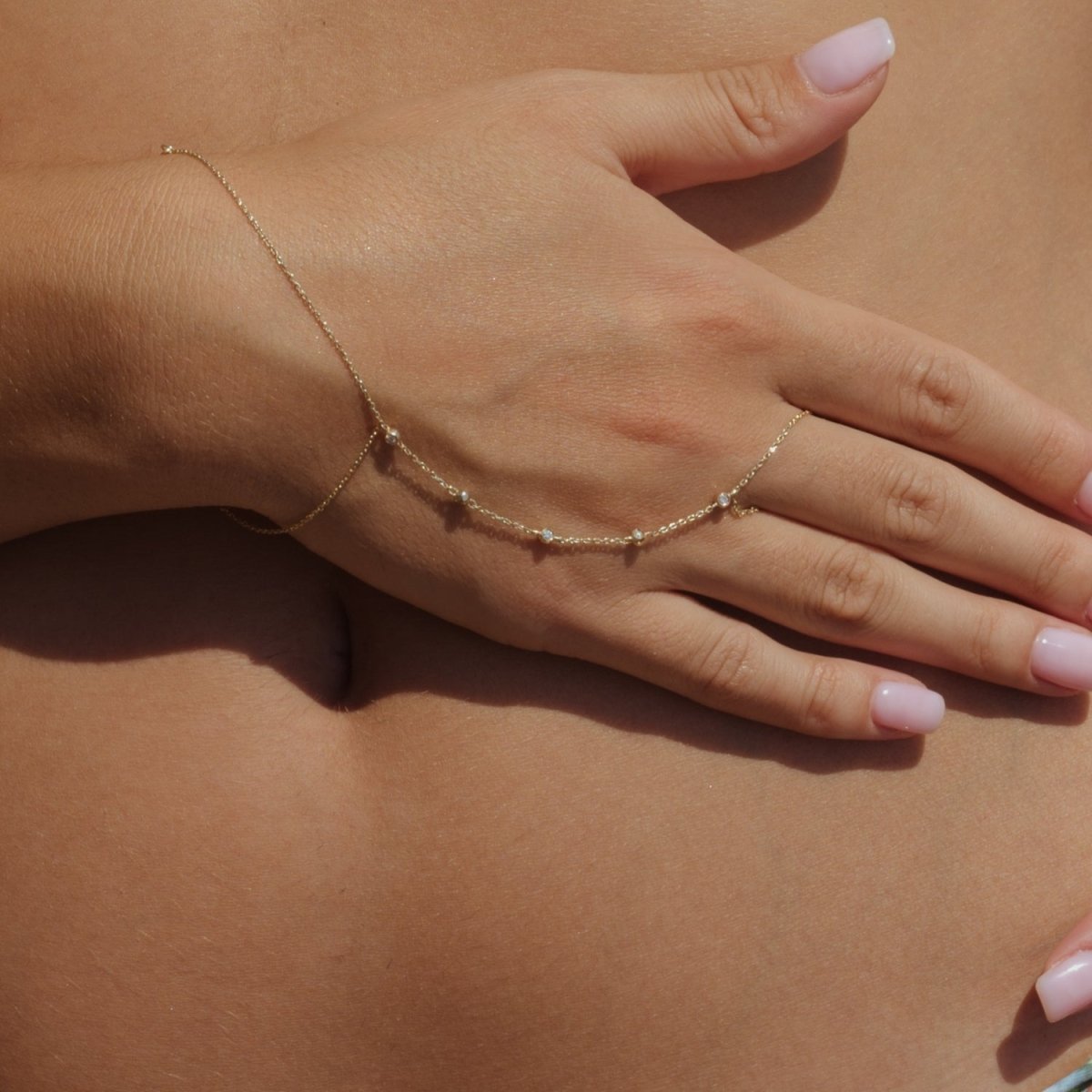
Studs and gold hoops are not interchangeable. They serve different visual purposes. A stud sits on the lobe as a point of light. A hoop draws a circle that catches the eye in motion. For a fully Mediterranean stack, pair studs with a hand chain bracelet on the wrist. A complete fine jewelry collection has at least one of each.
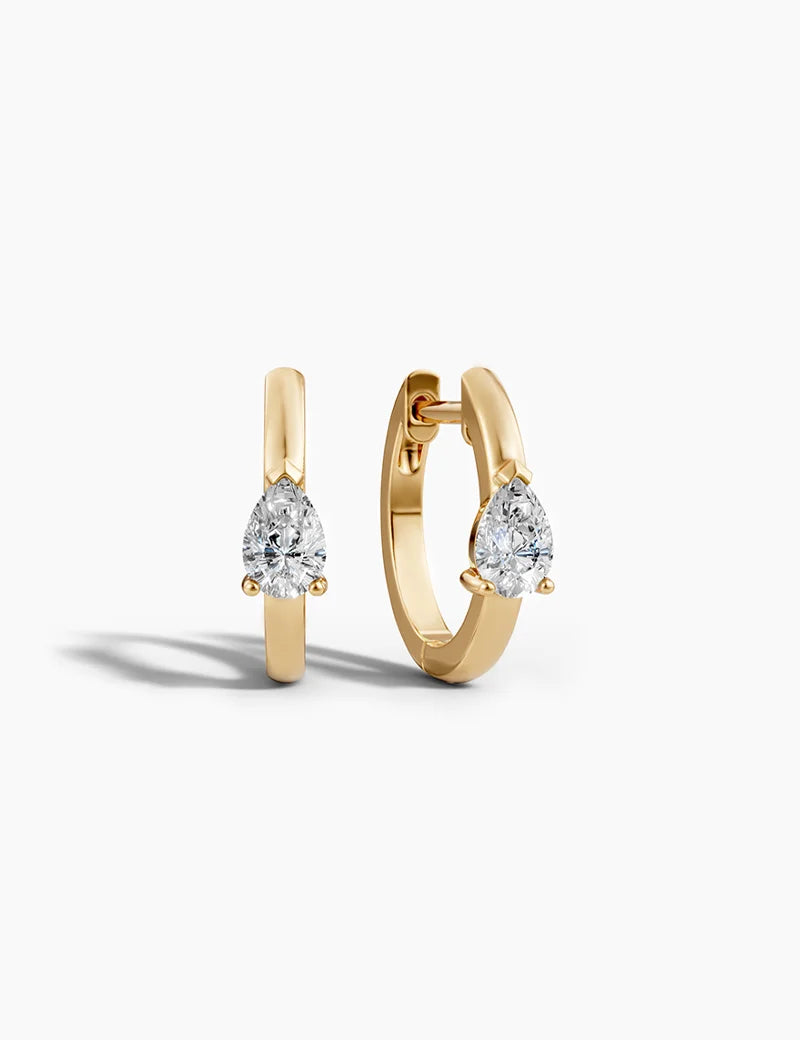
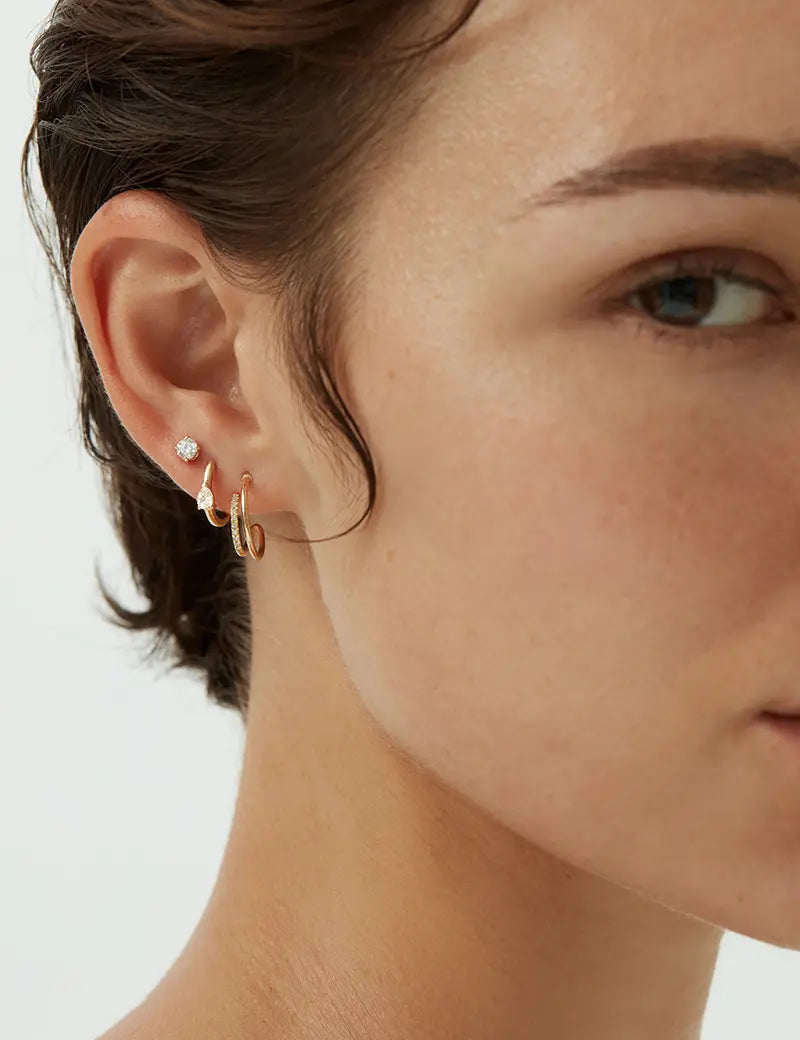
If you have a second piercing, my recommendation is a small stud in the first hole and a small hoop in the second. The visual hierarchy reads intentional. Two studs of the same size in two piercings reads accidental.
A pair of studs also pairs naturally with a dainty gold necklace at the collarbone. For more on the hoop side of the equation, our gold hoop earrings guide has the full breakdown.
The Customer Story I Always Tell
A woman walked into our workshop two years ago with a small Ziploc bag. Inside were a pair of 14k gold studs we had made in 2008 for her mother. Her mother had passed away. The daughter was getting married the following spring and wanted the studs polished and the backs replaced (the original backs had loosened from twenty years of daily wear).
The studs themselves were perfect. The gold had developed a soft glow from two decades against skin, but no thinning, no color change, no compromise. We polished them and put on fresh backs. She wore them to her wedding. They were the only piece of her mother's jewelry she wore that day, and she told me later they were what made her feel her mother was there.
That pair of studs is somewhere in Athens right now on a woman's ears every day. They will probably go to her daughter someday. That is what we mean by made to be inherited. It is not a marketing line. It is what a pair of solid gold studs actually does over decades.
Care, Which Is Almost Nothing
Solid gold does not tarnish. It does not need polish. It does not need ultrasonic cleaning. The simplest care routine is the right one.
Once a month, drop the studs in a bowl of warm water with a single drop of dish soap. Leave them for five minutes. Wipe gently with a soft cloth. Pat dry. The studs look new.
Things to avoid:
- Pulling the back off without supporting the front. The post can bend if forced. Hold the front, pull the back straight back.
- Sleeping with diamond studs in butterfly backs. They can come loose. Screw backs are fine.
- Spraying perfume directly onto the ears with earrings in. The alcohol does not damage the gold but can dull polish over time.
If a back loosens or breaks, send the pair back to us. We repair every piece we make. A replacement back is a five minute job. The clasp on the post can be re shaped if bent. The piece is the same piece you owned the day before.
We repair every piece we make. Forever. We wrote about why we insist on making every piece ourselves if you want the deeper story. Send your studs back twenty years from now with a worn back or a bent post and we fix them. That is not a marketing promise. It is how my grandfather operated, how my father operated, and how my brother and I operate now. A piece worth making is a piece worth keeping alive.
A Personal Note on Making Women's Jewelry as a Man
I do not wear what I make. ENEA is women's jewelry, and I am a man with thick wrists. But every piece I send out of this workshop is a piece I would put on my wife's wrist, or my daughter's neck twenty years from now. That is the test I apply before a piece ships.
My grandmother wore a pair of small gold studs every day of her life. My mother does too. The studs my mother wears were made by my father in 1989. She has worn them daily for thirty seven years. The gold has the same soft glow as the day they were finished. The backs have been replaced twice. The studs themselves are the same. That is what I am trying to make, every day, for someone else's mother and daughter.
What to Look For When You Buy
If you are buying a pair of gold studs from any maker, these are the questions that separate a pair worth keeping from one that ends up in a drawer:
- Is it solid gold or plated? The listing must say solid 14k gold or solid 10k gold. If it says gold filled, vermeil, gold plated, or gold tone, the studs are plated. They will not last.
- Are the backs the same material as the fronts? Cheap workshops put plated backs on solid fronts. Ask. If they cannot answer clearly, walk away.
- Is it stamped? Real gold is always stamped on the post or back. 14K, 585, 10K, or 417.
- What size? Confirm the size in millimeters. Small is meaningless without a number. 4mm to 5mm for daily wear.
- What is the repair policy? Will the maker replace a back, repair a bent post, polish the piece in twenty years? If they cannot, the piece is designed to be replaced, not kept.
A pair of solid gold studs made correctly is a piece you can wear for thirty years and pass to your daughter. We have customers wearing pieces from 1999 daily. The studs have not changed. That is what a stud should be.
Frequently Asked Questions
How much do real gold stud earrings cost?
A pair of solid 14k gold studs in standard 4mm to 5mm size typically runs between $150 and $300 depending on size and the maker. Solid 10k studs run between $90 and $200. Diamond studs (0.20 TCW lab grown, 14k gold setting) run between $300 and $600. Plated versions cost less but they are a different product entirely and will not last.
Can I sleep in gold stud earrings?
Yes, if they are solid gold with secure backs. Solid 14k or 10k gold will not react to skin overnight. Butterfly backs can come loose in sleep, so screw backs are safer for overnight wear. Most of our customers sleep in their studs without issue.
Will gold studs irritate sensitive ears?
Real solid 14k and 10k gold are too high in gold content to cause skin reactions in most cases. If your ears react, the studs are almost certainly plated, not solid. The plating wears through and exposes brass, which causes the reaction. Switch to solid gold and the irritation stops.
What size stud is right for me?
For most adult women, 4mm or 5mm is the answer. 4mm reads as classic minimalist, 5mm reads as slightly more present. If you have larger ear lobes or want a statement look, 6mm. If you prefer barely visible, 3mm. Anything above 8mm is occasion wear, not daily.
Are gold studs a good first solid gold piece?
Yes. Studs are the most universally wearable piece in fine jewelry. They work in every setting (office, evening, weekend), on every face shape, with every haircut and outfit. They sit at a lower price point than chains or rings, which makes them a sensible entry into solid gold without compromising on quality.
What is the difference between gold filled, gold plated, and solid gold studs?
Gold filled has a slightly thicker gold layer than gold plated, but both are plating over a base metal. Solid gold is gold all the way through. Only solid gold (stamped 14K, 585, 10K, or 417) lasts long-term. Gold filled and gold plated will wear through eventually, gold filled lasts longer than gold plated but neither matches solid.
The gold stud earring is the most worn piece of jewelry in human history. We have been making them in our Athens workshop for three generations. Every pair we ship is solid 14k or 10k gold (front and back), stamped, and built to be worn daily for decades.
Browse our gold stud earrings collection, explore our 14k gold jewelry, or read about our family workshop on our About page.
The pair your daughter inherits should be made by a workshop that has done this for three generations.