




I'll tell you something I've noticed after twenty years at the bench. A woman will try on six necklaces, debate between three pairs of earrings, and spend forty minutes choosing a ring. But a diamond bracelet? She puts it on, looks at her wrist, and goes quiet for a second. That little pause. That's the moment she knows.
My name is Laki Tasatzis. I'm a third generation goldsmith. My grandfather Thanasis started our workshop in Athens in 1953, and I grew up watching him set stones into bracelets by hand, one at a time, under a lamp that was older than my father. He used to say that a bracelet is the most honest piece of jewelry you can make because you simply cannot hide bad craftsmanship on a wrist. It moves too much. It catches too much light. Every link, every setting, every stone has to be absolutely right or the whole thing falls apart.
This guide is everything I know about diamond bracelets. Not the polished marketing version. The real version. The one where I tell you which styles are worth your money, which ones I actually put on my wife's wrist, and what I've learned from repairing other people's mistakes for two decades.
What Makes a Diamond Bracelet Different from a Gold Bracelet
I wrote a whole guide on gold bracelets for women not long ago, and the question I got most afterward was: "So what changes when you add diamonds?" My honest answer? Everything changes. And somehow nothing changes at the same time.
The chain is still chain. The clasp is still clasp. The weight on your wrist feels familiar. But the engineering underneath becomes a completely different animal. When you set a diamond into a bracelet, you're asking a tiny stone to survive constant movement, constant abuse. Your wrist bends hundreds of times a day. You bang it on desks. Steering wheels. Countertops. Door frames. That coffee mug you grab every morning without thinking.
A ring sits still on your finger. A necklace hangs and barely moves. A bracelet? A bracelet lives through impact every single day.
That's why setting style matters more on a bracelet than on any other piece of jewelry I make. The way we secure each stone is the difference between something that stays put for thirty years and something that loosens after six months. My grandfather had a rule about this: if a setting can't survive being worn to the workshop every day, it has no business being worn to an office every day either. I still follow that rule.
Tennis Bracelets: The One Everyone Asks About First
When most people say "diamond bracelet," what they're actually picturing is a tennis bracelet. A continuous line of diamonds set into a flexible chain that wraps the entire wrist. It's probably the most iconic piece of diamond jewelry after the engagement ring, and there's a good reason for that. Nothing else looks quite like it.
We make ours in three carat weights. The 1.50 carat total weight is the most delicate version. Each stone is about 1.5mm across, and on a wrist it reads as a thin sparkly line. Subtle enough for wearing every single day but visible enough that people notice and comment. The 2.50 carat total weight is what I'd call the sweet spot for most women. Stones are noticeably larger, the sparkle becomes more dramatic, but the bracelet still sits flat and comfortable and doesn't feel heavy. Then there's the 3.50 carat total weight. That's the statement piece. You see it from across the room. No question about it.
Here's something most people don't realize though. The setting in a tennis bracelet matters as much as the carat weight, maybe more. We use a four prong basket setting on ours where each diamond sits in its own little cradle of gold with four tiny prongs holding it secure. Some companies use two prong settings to save on gold. The stone sits less securely and I've seen them come loose. Others use channel settings where diamonds get sandwiched between two rails of gold. That works fine but you lose light coming in from the sides and the sparkle suffers.
I'll be direct about one thing. If you're choosing between a 1.50ctw bracelet with better quality stones and a 3.50ctw with lower quality stones at the same price, take the smaller one. Every time. Eleni, who runs our finishing department, tells customers this constantly and she's right. Fewer, better diamonds will always outshine a bracelet packed with mediocre ones. On a wrist, light quality absolutely beats quantity.
Bezel Set Diamond Bracelets: The Goldsmith's Favorite
Ask any goldsmith what they'd personally put on their partner's wrist and most of them will say bezel. I'm no different. A bezel set diamond bracelet wraps each stone in a thin wall of gold that surrounds the diamond on all sides. No prongs sticking up. No exposed edges anywhere. Just a smooth rim of metal hugging the stone completely.
Why do goldsmiths specifically love this setting? Because we see the failures of everything else. The diamond is physically enclosed in a bezel. It cannot fall out unless the gold itself breaks, and let me tell you, solid 14k gold does not break from normal daily wear. I've repaired hundreds of prong set bracelets over the years where a stone popped out because a single prong caught on a sweater sleeve or a jacket lining. Hundreds. How many bezel set bracelets have I repaired for the same problem? Exactly zero. That number is not an exaggeration.
Our Éclat Diamond Bezel Bracelet is the piece I find myself recommending most to anyone who says they want a diamond bracelet for genuine everyday wear. No worrying about snagging on fabric. No worrying about stone loss. You put it on in the morning and you forget about it completely until someone compliments it at lunch.
The trade off is real though and I want to be upfront about it. Bezel settings hide more of the diamond's surface area than prong settings do. You see the top face, the table and crown, but the sides are wrapped in gold. This means you get slightly less total sparkle compared to a prong set stone of the same size. Most people honestly never notice this difference on a bracelet because the individual stones are small and the constant movement of your wrist creates its own light show throughout the day.
Station Bracelets: Diamonds Spaced Along a Chain
A diamond station bracelet takes the opposite approach from a tennis bracelet. Instead of packing diamonds continuously around the wrist, you get individual stones or small clusters spaced evenly along a gold chain with breathing room between each one. It's a completely different philosophy.
I love making these because the design logic is so clean it almost designs itself. Three stations. Five stations. Seven stations. The chain does most of the talking and the diamonds punctuate. Think about the difference between a sentence written in all capital letters versus one with carefully placed emphasis. That's the difference between a tennis bracelet and a station bracelet.
Our Alinéa collection has several versions I'm proud of. The Trio Diamond Station Bracelet has three evenly spaced bezel set diamonds. Simple, clean, hard to get wrong. The Two Sided Bezel Diamond Station Bracelet has a design detail that I think is particularly clever: the bezels are open on both the top and bottom, so light enters the diamond from above and below simultaneously. This is one of those details you would never know about unless someone pointed it out, but it genuinely changes how the stones catch light when your wrist is in motion.
Station bracelets are also the easiest style to stack with other pieces. Because the chain sections between diamonds are plain gold, they sit flat against other bracelets without visual competition. I see customers all the time pairing a diamond station bracelet with a simple gold chain bracelet and the combination looks incredible. Two completely different textures that complement each other precisely because neither one is trying to dominate.
Diamond By The Yard Bracelets
This is technically a variation of the station bracelet, but the name carries its own recognition and I think it deserves its own section. Diamond by the yard means evenly spaced diamonds set directly into a chain at regular intervals. The term comes from the idea that you could, in theory, keep extending the chain forever. One diamond every inch. Or every centimeter. However you want to space them.
In practice a diamond by the yard bracelet usually carries five to seven stones. Ours use bezel settings because of course they do. My grandfather would come back from his grave if I used prongs on a piece meant for everyday wear and I am not exaggerating about that. The Alinéa Diamond By The Yard Bracelet is our version. Clean. Minimal. Goes with literally everything.
If you want me to be precise about what separates these two styles: a "station bracelet" can use any setting style and any grouping of stones, whether that's clusters, bars, or individual diamonds. "Diamond by the yard" specifically means single stones placed at equal intervals. They look nearly identical in photographs. On your actual wrist the difference is in the rhythm. By the yard feels more measured, almost mathematical in its spacing. Station feels more deliberately designed. Both approaches are beautiful and the choice really comes down to which philosophy speaks to you.
Hand Chain Diamond Bracelets
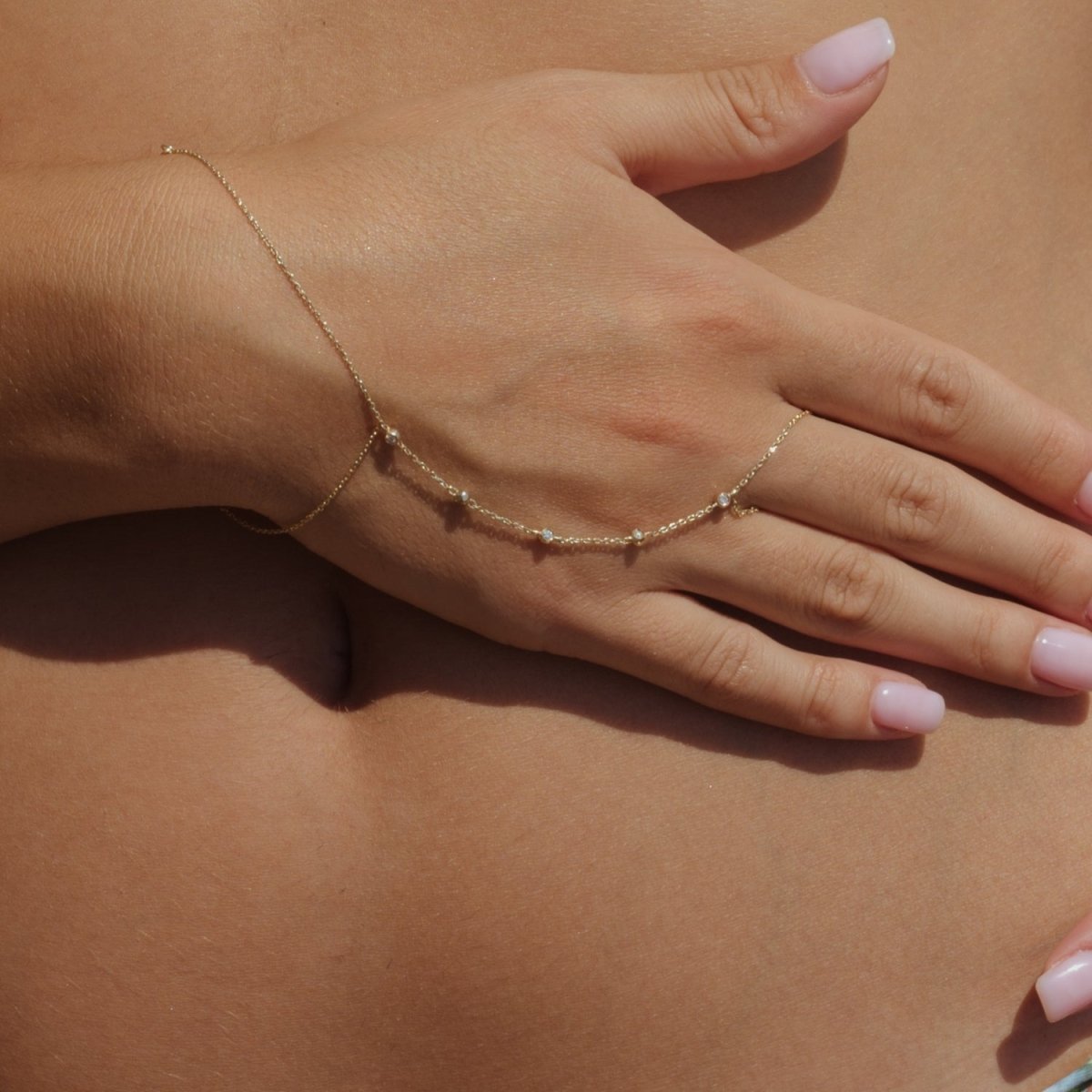
This is the style that stops conversations. A hand chain bracelet connects a bracelet around the wrist to a ring on the finger with one or more delicate chains running across the back of the hand. Add diamonds to that equation and you've got something that genuinely makes people pause mid sentence to ask what you're wearing.
Our Lien Hand Chain Diamond Bracelet is one of the pieces I'm most proud of in our entire collection. It was actually one of the very first designs I created when I took over design responsibility from my father. The bracelet portion is a delicate gold chain with bezel set diamonds and then a single chain extends across the back of the hand to a simple ring. The whole thing moves together. Flows together. It looks like it was always supposed to exist as one piece.
I won't pretend this style works for everyone. A hand chain is more dramatic than a standard bracelet by a significant margin. It shows up on your hand in a way that people notice immediately. But for the right person, at the right moment, there is genuinely nothing else like it in jewelry. My brother Dimitris, who is our COO, likes to say the hand chain is the piece that converts browsers into buyers. People land on our site looking for a simple diamond bracelet and leave with something they had never even imagined wearing before.
Lariat Diamond Bracelets
A lariat bracelet works differently from everything else I've described so far. There is no traditional clasp. Instead, the chain passes through a loop or slider mechanism, and the excess length hangs down elegantly from your wrist. Put a diamond at the end of that hanging chain and you get a kind of movement that no other bracelet style can replicate.
Our Nema Lariat Diamond Bracelet places a single diamond at the tail of the lariat. Every time you gesture with your hand or reach for something, that diamond swings slightly and catches light in a completely unpredictable way. There's a real difference between static sparkle, which is beautiful on its own, and dynamic sparkle, which is genuinely mesmerizing to watch.
The lariat also solves a practical problem that other styles can't. Because there is no fixed clasp, the chain slides freely to fit any wrist size. This makes it arguably the best diamond bracelet style for gifting someone. You don't need to know the recipient's exact wrist measurement. You don't need to worry about resizing afterward. The design handles all of that on its own.
Lab Grown vs Natural Diamonds in Bracelets
I wrote a complete guide comparing natural and lab grown diamonds already, so I won't rehash everything here. But there is one thing I want to say specifically about bracelets: this is where lab grown diamonds make the most financial sense of any jewelry category.
Think about the math for a moment. A tennis bracelet with 2.50 carats total weight uses anywhere from 25 to 50 individual stones depending on stone size. If every single one of those is a natural diamond, the cost compounds fast. Lab grown diamonds are chemically, physically, and optically identical to natural ones. Same hardness at 10 on the Mohs scale. Same refractive index. Same fire and brilliance when light hits them. The only difference between the two is where they formed. One grew underground over billions of years and the other grew in a laboratory over a few weeks.
For a bracelet where you need dozens of small stones and realistically nobody is ever going to put a jeweler's loupe to your wrist at dinner, lab grown is what I recommend almost every single time. The money you save lets you either go up in total carat weight or invest more in the gold itself, which is ultimately what gives the bracelet its weight on your wrist, its feel against your skin, and its ability to last for decades.
How to Choose the Right Diamond Bracelet
After making thousands of these pieces over the years, I've noticed the decision almost always comes down to three practical questions.
How often will you actually wear it? If the answer is every single day, go bezel set without hesitation. The security simply cannot be matched by anything else. If it's mainly for special occasions and date nights, a prong set tennis bracelet gives you maximum sparkle and the reduced daily durability becomes irrelevant when you're only wearing it a few times each month.
What else is already on your wrist? If you're someone who likes to stack multiple pieces together, station bracelets and diamond by the yard styles play well with other bracelets because they don't compete visually. If you want one single bracelet and nothing else alongside it, a tennis bracelet creates the biggest visual impact standing alone.
How do you feel about jewelry maintenance? Prong settings should be checked by a jeweler about once a year to confirm nothing has loosened from daily wear. Bezel settings need essentially zero maintenance. If you're the type of person who puts jewelry on in the morning and completely forgets about it until bedtime, which is most people and there is absolutely nothing wrong with that, bezel is going to be your best friend.
Sizing a Diamond Bracelet
Standard bracelet length is 7 inches. That fits most women's wrists with enough room for a little bit of natural movement. If you want it to sit snug like a bangle, go down to 6.5 inches. If you prefer it loose and relaxed, go up to 7.5 inches.
Here's the sizing trick we share with every customer who asks: wrap a piece of string around your wrist exactly where you'd wear the bracelet. Mark the spot where the string meets itself. Measure that length flat, then add half an inch. That half inch is your comfort margin. Trust me on this. A bracelet that sits right against the skin with absolutely zero gap between metal and wrist will start feeling restrictive after about an hour of wear.
For tennis bracelets specifically you actually want slightly more drape than your instinct tells you. When you hold your arm out straight, the bracelet should be able to slide roughly an inch up and down your wrist freely. That movement isn't a flaw. It's intentional. That sliding motion is exactly how diamonds catch light from constantly changing angles as the bracelet shifts position throughout your day.
Caring for Your Diamond Bracelet
Diamonds are the hardest natural substance on earth. But the gold that holds them in place is considerably softer, and that gold is what needs your attention. Here's what I tell every single customer who takes home a diamond bracelet from our collection.
Warm water. A single drop of dish soap. A soft toothbrush. Soak the bracelet for about ten minutes, brush gently around the settings where grime likes to accumulate, rinse everything under running water, and pat dry with a clean cloth. That's the entire routine. Do this once a month and your bracelet will look exactly the way it did the day you first opened the box.
What you should avoid: chlorine from pools and hot tubs will damage gold over time. Harsh cleaning chemicals are even worse. And if your bracelet is prong set, take it off before sleeping because prongs can catch on sheets and pillowcases and gradually bend out of position. Bezel set pieces handle sleeping just fine since the smooth bezels protect the stones from any fabric friction.
One last thing that surprises almost everyone I tell: take your bracelet off before you apply hand cream or lotion. The oils leave a thin film on the diamond surfaces that absolutely kills their sparkle. It's not permanent damage at all, but it does mean you'll end up needing to clean the bracelet more frequently than necessary.
Frequently Asked Questions About Diamond Bracelets
What is a good carat weight for a diamond bracelet?
For a tennis bracelet, somewhere between 1.50 and 2.50 total carat weight hits the sweet spot for most people. Visible and elegant without crossing into overwhelming territory. For station and by the yard styles, individual stones in the 0.05 to 0.10 carat range create a delicate everyday look. The ideal carat weight really depends on your personal style and whether you lean toward subtle shimmer or want more noticeable sparkle.
Can you wear a diamond bracelet every day?
Yes, and I'd encourage it. Especially with a bezel set bracelet, where the diamonds are fully enclosed in gold and protected from the bumps and snags of daily life. Tennis bracelets with prong settings can also handle daily wear, but I'd recommend having a jeweler check the prongs once a year just to confirm nothing has worked itself loose from all that wrist movement.
Are lab grown diamond bracelets worth it?
In my professional opinion, absolutely. Lab grown diamonds are chemically and optically the same material as natural diamonds. When you're setting 20 to 50 small stones into a single bracelet, the cost savings from choosing lab grown are substantial, and nobody on earth can see the difference on your wrist without specialized testing equipment. Those savings let you put more money toward carat weight or gold quality, both of which you will actually notice and feel.
What is the difference between a tennis bracelet and a diamond station bracelet?
A tennis bracelet sets diamonds continuously around the entire circumference with no gaps between stones. You get an unbroken line of sparkle. A station bracelet takes a different approach: individual diamonds or small clusters sit along a gold chain with visible stretches of plain chain between each stone. Tennis bracelets make a bolder visual statement. Station bracelets create something lighter and more understated, where diamonds serve as accents rather than covering the entire piece.
How should a diamond bracelet fit?
It should have room to move. When your arm is extended straight out, the bracelet should slide about one inch up and down your wrist. To find your size, measure your bare wrist with a string, then add half an inch for comfort. Standard sizing is 7 inches, which works for most women. Go with 6.5 for a snugger fit or 7.5 if you prefer a more relaxed drape.
How do you clean a diamond bracelet at home?
The method we recommend is simple: soak in warm water with a drop of dish soap for ten minutes, gently brush around the settings with a soft bristled toothbrush, rinse under running water, and pat dry. Stay away from chlorine and harsh chemicals. And here's one people always forget: remove the bracelet before applying hand lotion, because those oils coat the diamond surfaces and make them look dull until the next cleaning.